


Page 304 - Complete Birds of Britain and Europe (DK - RSPB)
P. 304
CHATS AND THRUSHES
       Order Passeriformes    Family Turdidae        Species Oenanthe leucura
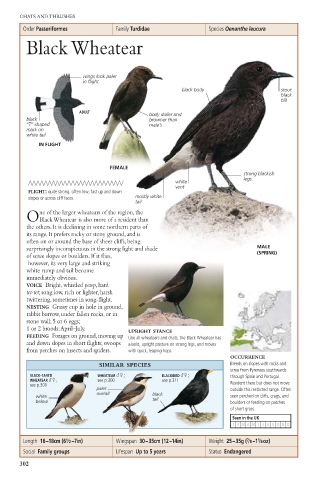
        Black Wheatear


                      wings look paler
                      in flight
                                              black body               stout
                                                                       black
                                                                       bill
                     ADULT
                                      body duller and
        black                         browner than
        “T”-shaped                    male’s
        mark on
        white tail
           IN FLIGHT

                            FEMALE
                                                             strong blackish
                                                             legs
                                             white
                                             vent
        FLIGHT: quite strong, often low; fast up and down
        slopes or across cliff faces.  mostly white
                                   tail
           ne of the larger wheatears of the region, the
        OBlack Wheatear is also more of a resident than
        the others. It is declining in some northern parts of
        its range. It prefers rocky or stony ground, and is
        often on or around the base of sheer cliffs, being
        surprisingly inconspicuous in the strong light and shade  MALE
        of scree slopes or boulders. If it flies,                (SPRING)
        however, its very large and striking
        white rump and tail become
        immediately obvious.
        VOICE Bright, whistled pewp, hard
        tet-tet; song low, rich or lighter, harsh
        twittering, sometimes in song-flight.
        NESTING Grassy cup in hole in ground,
        rabbit burrow, under fallen rocks, or in
        stone wall; 5 or 6 eggs;
        1 or 2 broods;April–July.  UPRIGHT STANCE
        FEEDING Forages on ground,moving up  Like all wheatears and chats, the Black Wheatear has
        and down slopes in short flights; swoops  a bold, upright posture on strong legs, and moves
        from perches on insects and spiders.  with quick, leaping hops.
                                                          OCCURRENCE
                          SIMILAR SPECIES                 Breeds on slopes with rocks and
                                                          scree from Pyrenees southwards
        BLACK-EARED      WHEATEAR 32;    BLACKBIRD 32;    through Spain and Portugal.
        WHEATEAR 32;     see p.300       see p.311        Resident there but does not move
        see p.301
                         paler                            outside this restricted range. Often
                         overall       black
          white                        tail               seen perched on cliffs, crags, and
          below                                           boulders or feeding on patches
                                                          of short grass.
                                                           Seen in the UK
                                                           JF M A  M J  JA S ON D
       Length  16–18cm (6 1 ⁄2 –7in)  Wingspan  30–35cm (12–14in)  Weight  25–35g ( 7 ⁄8 –1 1 ⁄4oz)
       Social  Family groups  Lifespan  Up to 5 years  Status  Endangered
      302

