


Page 309 - Complete Birds of Britain and Europe (DK - RSPB)
P. 309
CHATS AND THRUSHES
       Order Passeriformes    Family Turdidae        Species Turdus philomelos
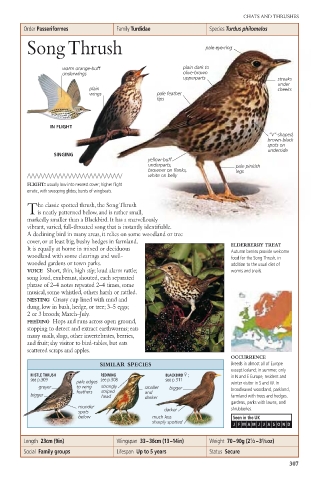
        Song Thrush                                 pale eye-ring


                 warm orange-buff             plain dark to
                 underwings                   olive-brown
                                              upperparts              streaks
                                                                      under
                       plain                                          cheeks
                       wings            pale feather
                                        tips

             IN FLIGHT
                                                                    “V”-shaped,
                                                                   brown-black
                                                                   spots on
                                                                   underside
              SINGING
                                      yellow-buff
                                      underparts,           pale pinkish
                                      browner on flanks,    legs
                                      white on belly
        FLIGHT: usually low into nearest cover; higher flight
        erratic, with swooping glides; bursts of wingbeats.
          he classic spotted thrush, the Song Thrush
        Tis neatly patterned below, and is rather small,
        markedly smaller than a Blackbird. It has a marvellously
        vibrant, varied, full-throated song that is instantly identifiable.
        A declining bird in many areas, it relies on some woodland or tree
        cover, or at least big, bushy hedges in farmland.  ELDERBERRY TREAT
        It is equally at home in mixed or deciduous       Autumn berries provide welcome
        woodland with some clearings and well-            food for the Song Thrush, in
        wooded gardens or town parks.                     addition to the usual diet of
        VOICE Short, thin, high stip; loud alarm rattle;  worms and snails.
        song loud, exuberant, shouted, each separated
        phrase of 2–4 notes repeated 2–4 times, some
        musical, some whistled, others harsh or rattled.
        NESTING Grassy cup lined with mud and
        dung, low in bush, hedge, or tree; 3–5 eggs;
        2 or 3 broods; March–July.
        FEEDING Hops and runs across open ground,
        stopping to detect and extract earthworms; eats
        many snails, slugs, other invertebrates, berries,
        and fruit; shy visitor to bird-tables, but eats
        scattered scraps and apples.
                                                          OCCURRENCE
                          SIMILAR SPECIES                 Breeds in almost all of Europe
                                                          except Iceland; in summer, only
         MISTLE THRUSH    REDWING         BLACKBIRD 2;    in N and E Europe, resident and
         see p.309  pale edges  see p.308  see p.311      winter visitor in S and W. In
           greyer   to wing  strongly  smaller  bigger    broadleaved woodland, parkland,
                    feathers  striped  and
         bigger           head       darker               farmland with trees and hedges,
                                                          gardens, parks with lawns, and
                    rounder               darker          shrubberies.
                    spots
                    below              much less           Seen in the UK
                                       sharply spotted
                                                           J  F  M  A  M  JJ A S O  N  D
       Length  23cm (9in)     Wingspan  33–36cm (13–14in)  Weight  70–90g (2 1 ⁄2 –3 1 ⁄4oz)
       Social  Family groups  Lifespan  Up to 5 years  Status  Secure
                                                                         307

