


Page 310 - Complete Birds of Britain and Europe (DK - RSPB)
P. 310
CHATS AND THRUSHES
       Order Passeriformes    Family Turdidae        Species Turdus iliacus
        Redwing
                                                       dark cap


                                              pale stripe
                            reddish           over eye
                            underwing
        white spot          coverts
        beside tail                                                  dark
                                                                     cheeks
                                   dark brown
                                   back
                  IN FLIGHT

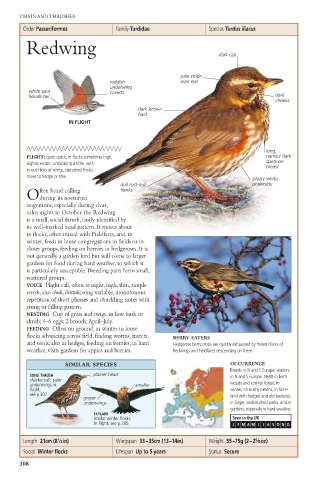
                                                                   long,
        FLIGHT: quite quick; in flocks sometimes high,             narrow dark
                                                                   spots on
        slightly erratic, undulating a little, with
                                                                   breast
        in-out flicks of wings; disturbed flocks
        move to hedge or tree.
                                                                silvery white
                               dull rust-red                    underside
           ften heard calling  flanks
        Oduring its nocturnal
        migrations, especially during clear,
        calm nights in October, the Redwing
        is a small, social thrush, easily identified by
        its well-marked head pattern. It moves about
        in flocks, often mixed with Fieldfares, and, in
        winter, feeds in loose congregations in fields or in
        closer groups, feeding on berries in hedgerows. It is
        not generally a garden bird but will come to larger
        gardens for food during hard weather, to which it
        is particularly susceptible. Breeding pairs form small,
        scattered groups.
        VOICE Flight call, often at night, high, thin, simple
        seeeeh, also chuk, chittuk; song variable, monotonous
        repetition of short phrases and chuckling notes with
        rising or falling pattern.
        NESTING Cup of grass and twigs, in low bush or
        shrub; 4–6 eggs; 2 broods;April–July.
        FEEDING Often on ground, in winter in loose
        flocks advancing across field, finding worms, insects,  BERRY EATERS
        and seeds; also in hedges, feeding on berries; in hard  Hedgerow berry crops are quickly exhausted by mixed flocks of
        weather, visits gardens for apples and berries.  Redwings and Fieldfares descending on them.
                 SIMILAR SPECIES                          OCCURRENCE
                                                          Breeds in N and E Europe; winters
        SONG THRUSH     plainer head                      in N and S Europe. Nests in birch
        shorter call; paler
        underwings in              smaller                woods and conifer forest; in
        flight;                                           winter, on bushy heaths, in farm-
        see p.307                                         land with hedges and old pastures,
                      greyer
                      underwings                          in larger, undisturbed parks, and in
                                                          gardens, especially in hard weather.
                        SKYLARK
                        similar winter flocks              Seen in the UK
                        in flight; see p.265               J  F  M  A  M  JJ A S O  N  D
       Length  21cm (8 1 ⁄2in)  Wingspan  33–35cm (13–14in)  Weight  55–75g (2–2 5 ⁄8oz)
       Social  Winter flocks  Lifespan  Up to 5 years  Status  Secure
      308

