


Page 312 - Complete Birds of Britain and Europe (DK - RSPB)
P. 312
CHATS AND THRUSHES
       Order Passeriformes    Family Turdidae        Species Turdus pilaris
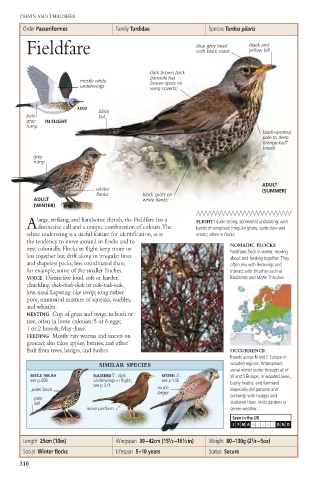
        Fieldfare                                 blue-grey head  black and
                                                               yellow bill
                                                  with black mask
                                      dark brown back
                                      (juvenile has
                     mostly white     brown spots on
                     underwings       wing coverts)
                    ADULT
                          black
        pale              tail
        grey  IN FLIGHT
        rump
                                                                  black-spotted,
                                                                  pale to deep
                                                                  orange-buff
                                                                  breast
         grey
         rump
                                                                  ADULT
                         whiter                                   (SUMMER)
                         flanks     black spots on
         ADULT                      white flanks
         (WINTER)
          large, striking, and handsome thrush, the Fieldfare has a  FLIGHT: quite strong, somewhat undulating, with
        Adistinctive call and a unique combination of colours.The   bursts of wingbeat; irregular glides, quite slow and
        white underwing is a useful feature for identification, as is   erratic; often in flocks.
        the tendency to move around in flocks and to
        nest colonially. Flocks in flight keep more or    NOMADIC FLOCKS
                                                          Fieldfares flock in winter, moving
        less together but drift along in irregular lines  about and feeding together. They
        and shapeless packs, less coordinated than,       often mix with Redwings and
        for example, some of the smaller finches.         interact with thrushes such as
        VOICE Distinctive loud, soft or harder,           Blackbirds and Mistle Thrushes.
        chuckling chak-chak-chak or tsak-tsak-tsak,
        low, nasal Lapwing-like weeip; song rather
        poor, unmusical mixture of squeaks, warbles,
        and whistles.
        NESTING Cup of grass and twigs, in bush or
        tree, often in loose colonies; 5 or 6 eggs;
        1 or 2 broods; May–June.
        FEEDING Mostly eats worms and insects on
        ground; also takes apples, berries, and other
        fruit from trees, hedges, and bushes.             OCCURRENCE
                                                          Breeds across N and E Europe in
                          SIMILAR SPECIES                 wooded regions. Widespread,
                                                          social winter visitor through all of
         MISTLE THRUSH  BLACKBIRD 2; dark  KESTREL 3;     W and S Europe, in wooded areas,
         see p.309      underwings in flight;  see p.140  bushy heaths, and farmland
                        see p.311
         paler back                     much              (especially old pastures and
                                        larger
          pale                                            orchards) with hedges and
          tail                                            scattered trees. Visits gardens in
                       more uniform                       severe weather.
                                                           Seen in the UK
                                                           JF M A  M J  JA S ON D
       Length  25cm (10in)    Wingspan  39–42cm (15 1 ⁄2 –16 1 ⁄2in)  Weight  80–130g (2 7 ⁄8 –5oz)
       Social  Winter flocks  Lifespan  5–10 years   Status  Secure
      310

