


Page 311 - Complete Birds of Britain and Europe (DK - RSPB)
P. 311
CHATS AND THRUSHES
       Order Passeriformes    Family Turdidae        Species Turdus viscivorus
        Mistle Thrush

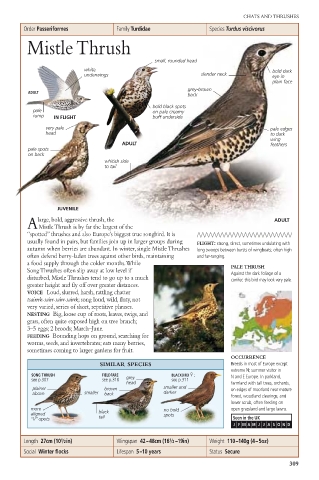
                                       small, rounded head
                      white                                          bold dark
                      underwings                   slender neck      eye in
                                                                     plain face
                                                grey-brown
        ADULT
                                                back
                                       bold black spots
         pale                          on pale creamy
         rump  IN FLIGHT               buff underside
            very pale                                               pale edges
            head                                                    to dark
                                                                    wing
                               ADULT                                feathers
        pale spots
        on back
                           whitish side
                           to tail


               JUVENILE
          large, bold, aggressive thrush, the                        ADULT
        AMistle Thrush is by far the largest of the
        “spotted” thrushes and also Europe’s biggest true songbird. It is
        usually found in pairs, but families join up in larger groups during  FLIGHT: strong, direct, sometimes undulating with
        autumn when berries are abundant. In winter, single Mistle Thrushes  long swoops between bursts of wingbeats; often high
        often defend berry-laden trees against other birds, maintaining   and far-ranging.
        a food supply through the colder months.While     PALE THRUSH
        Song Thrushes often slip away at low level if     Against the dark foliage of a
        disturbed, Mistle Thrushes tend to go up to a much  conifer, this bird may look very pale.
        greater height and fly off over greater distances.
        VOICE Loud, slurred, harsh, rattling chatter
        tsairrrk-sairr-sairr-sairrk; song loud, wild, fluty, not
        very varied, series of short, repetitive phrases.
        NESTING Big, loose cup of roots, leaves, twigs, and
        grass, often quite exposed high on tree branch;
        3–5 eggs; 2 broods; March–June.
        FEEDING Bounding hops on ground, searching for
        worms, seeds, and invertebrates; eats many berries,
        sometimes coming to larger gardens for fruit.
                                                          OCCURRENCE
                          SIMILAR SPECIES                 Breeds in most of Europe except
                                                          extreme N; summer visitor in
         SONG THRUSH      FIELDFARE         BLACKBIRD 2;  N and E Europe. In parkland,
         see p.307        see p.310  grey   see p.311
                                head                      farmland with tall trees, orchards,
         plainer           brown          smaller and     on edges of moorland near mature
         above        smaller  back       darker
                                                          forest, woodland clearings, and
                                                          lower scrub, often feeding on
         more                             no bold         open grassland and large lawns.
         aligned          black           spots
                          tail
         “V”-spots                                         Seen in the UK
                                                           J  F  M  A  M  JJ A S O  N  D
       Length  27cm (10 1 ⁄2in)  Wingspan  42–48cm (16 1 ⁄2 –19in)  Weight  110–140g (4–5oz)
       Social  Winter flocks  Lifespan  5–10 years   Status  Secure
                                                                         309

