


Page 330 - Complete Birds of Britain and Europe (DK - RSPB)
P. 330
WARBLERS AND ALLIES
       Order Passeriformes    Family Sylviidae       Species Locustella naevia
        Grasshopper Warbler


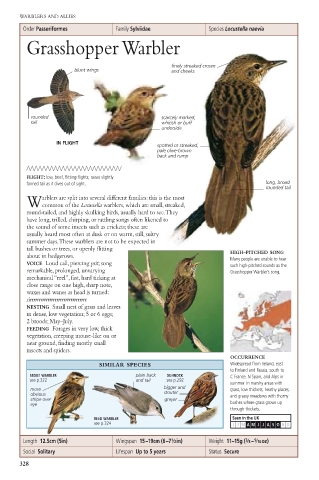
                                            finely streaked crown
                    blunt wings             and cheeks


         rounded                         scarcely marked,
         tail                            whitish or buff
                                         underside
               IN FLIGHT
                                        spotted or streaked,
                                        pale olive-brown
                                        back and rump
        FLIGHT: low, brief, flitting flights; raises slightly
        fanned tail as it dives out of sight.                      long, broad
                                                                   rounded tail
            arblers are split into several different families: this is the most
        Wcommon of the Locustella warblers, which are small, streaked,
        round-tailed, and highly skulking birds, usually hard to see.They
        have long, trilled, chirping, or rattling songs often likened to
        the sound of some insects such as crickets; these are
        usually heard most often at dusk or on warm, still, sultry
        summer days.These warblers are not to be expected in
        tall bushes or trees, or openly flitting
        about in hedgerows.                               HIGH-PITCHED SONG
                                                          Many people are unable to hear
        VOICE Loud call, piercing psit; song              such high-pitched sounds as the
        remarkable, prolonged, unvarying                  Grasshopper Warbler’s song.
        mechanical “reel”, fast, hard ticking at
        close range on one high, sharp note,
        waxes and wanes as head is turned:
        sirrrrrrrrrrrrrrrrrrrrrrrrrrrrrrrr.
        NESTING Small nest of grass and leaves
        in dense, low vegetation; 5 or 6 eggs;
        2 broods; May–July.
        FEEDING Forages in very low, thick
        vegetation, creeping mouse-like on or
        near ground, finding mostly small
        insects and spiders.
                                                          OCCURRENCE
                          SIMILAR SPECIES                 Widespread from Ireland, east
                                                          to Finland and Russia, south to
        SEDGE WARBLER              plain back  DUNNOCK    C France, N Spain, and Alps in
        see p.322                  and tail  see p.292
                                                          summer. In marshy areas with
         more                             bigger and      grass, low thickets, heathy places,
         obvious                          stouter         and grassy meadows with thorny
         stripe over                      greyer
         eye                                              bushes where grass grows up
                                                          through thickets.
                        REED WARBLER                       Seen in the UK
                        see p.324                          J F M A  M  JJ A S O  N D
       Length  12.5cm (5in)   Wingspan  15–19cm (6–7 1 ⁄2in)  Weight  11–15g ( 3 ⁄8 – 9 ⁄16oz)
       Social  Solitary       Lifespan  Up to 5 years  Status  Secure
      328

