


Page 332 - Complete Birds of Britain and Europe (DK - RSPB)
P. 332
WARBLERS AND ALLIES
       Order Passeriformes    Family Sylviidae       Species Cettia cetti
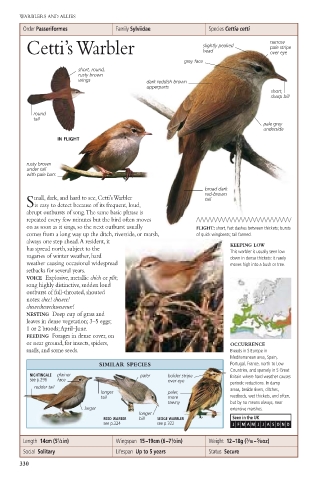
        Cetti’s Warbler                            slightly peaked  narrow
                                                                    pale stripe
                                                   head
                                                                    over eye
                                               grey face
                    short, round,
                    rusty brown
                    wings            dark reddish brown
                                     upperparts
                                                                    short,
                                                                    sharp bill
         round
         tail
                                                                  pale grey
                                                                  underside
               IN FLIGHT


        rusty brown
        under tail
        with pale bars
                                                    broad dark
                                                    red-brown
          mall, dark, and hard to see, Cetti’s Warbler  tail
        Sis easy to detect because of its frequent, loud,
        abrupt outbursts of song.The same basic phrase is
        repeated every few minutes but the bird often moves
        on as soon as it sings, so the next outburst usually  FLIGHT: short, fast dashes between thickets; bursts
        comes from a long way up the ditch, riverside, or marsh,  of quick wingbeats; tail fanned.
        always one step ahead.A resident, it              KEEPING LOW
        has spread north, subject to the                  This warbler is usually seen low
        vagaries of winter weather, hard                  down in dense thickets: it rarely
        weather causing occasional widespread             moves high into a bush or tree.
        setbacks for several years.
        VOICE Explosive, metallic chich or plit;
        song highly distinctive, sudden loud
        outburst of full-throated, shouted
        notes: chee! chewee!
        chewechewechwewewe!
        NESTING Deep cup of grass and
        leaves in dense vegetation; 3–5 eggs;
        1 or 2 broods;April–June.
        FEEDING Forages in dense cover, on
        or near ground, for insects, spiders,             OCCURRENCE
        snails, and some seeds.                           Breeds in S Europe in
                                                          Mediterranean area, Spain,
                          SIMILAR SPECIES                 Portugal, France, north to Low
                                                          Countries, and sparsely in S Great
        NIGHTINGALE  plainer        paler  bolder stripe  Britain where hard weather causes
        see p.296  face                    over eye       periodic reductions. In damp
          redder tail                                     areas, beside rivers, ditches,
                          longer           paler,
                          tail             more           reedbeds, wet thickets, and often,
                                           tawny          but by no means always, near
                      larger                              extensive marshes.
                                    longer
                           REED WARBER  bill  SEDGE WARBLER  Seen in the UK
                           see p.324    see p.322          J  F  M  A  M  JJ A S O  N  D
       Length  14cm (5 1 ⁄2in)  Wingspan  15–19cm (6–7 1 ⁄2in)  Weight  12–18g ( 7 ⁄16 – 5 ⁄8oz)
       Social  Solitary       Lifespan  Up to 5 years  Status  Secure
      330

