


Page 379 - Complete Birds of Britain and Europe (DK - RSPB)
P. 379
SPARROWS
       Order Passeriformes    Family Passeridae      Species Passer montanus
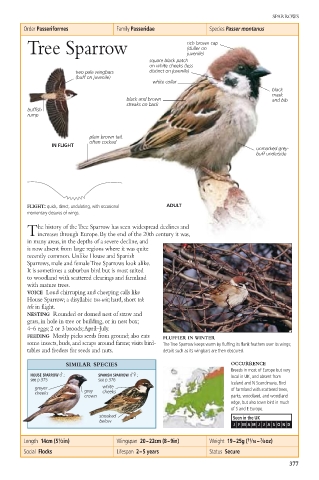
        Tree Sparrow                           rich brown cap
                                               (duller on
                                               juvenile)
                                      square black patch
                                      on white cheeks (less
                    two pale wingbars  distinct on juvenile)
                    (buff on juvenile)
                                       white collar
                                                                     black
                                                                     mask
                                black and brown                      and bib
                                streaks on back
        buffish
        rump
                       plain brown tail,
                       often cocked
              IN FLIGHT
                                                                 unmarked grey-
                                                                 buff underside


        FLIGHT: quick, direct, undulating, with occasional  ADULT
        momentary closures of wings.
          he history of the Tree Sparrow has seen widespread declines and
        Tincreases through Europe. By the end of the 20th century it was,
        in many areas, in the depths of a severe decline, and
        is now absent from large regions where it was quite
        recently common. Unlike House and Spanish
        Sparrows, male and female Tree Sparrows look alike.
        It is sometimes a suburban bird but is most suited
        to woodland with scattered clearings and farmland
        with mature trees.
        VOICE Loud chirruping and cheeping calls like
        House Sparrow; a disyllabic tsu-wit; hard, short tek
        tek in flight.
        NESTING Rounded or domed nest of straw and
        grass, in hole in tree or building, or in nest box;
        4–6 eggs; 2 or 3 broods;April–July.
        FEEDING Mostly picks seeds from ground; also eats  FLUFFIER IN WINTER
        some insects, buds, and scraps around farms; visits bird-  The Tree Sparrow keeps warm by fluffing its flank feathers over its wings;
        tables and feeders for seeds and nuts.  details such as its wingbars are then obscured.
                 SIMILAR SPECIES                          OCCURRENCE
                                                          Breeds in most of Europe but very
         HOUSE SPARROW 3;  SPANISH SPARROW 32;            local in UK, and absent from
         see p.375       see p.376
                                                          Iceland and N Scandinavia. Bird
          greyer      grey  white                         of farmland with scattered trees,
          cheeks          cheeks
                      crown                               parks, woodland, and woodland
                                                          edge, but also town bird in much
                                                          of S and E Europe.
                          streaked                         Seen in the UK
                          below
                                                           J  F  M  A  M  JJ A S O  N  D
       Length  14cm (5 1 ⁄2in)  Wingspan  20–22cm (8–9in)  Weight  19–25g ( 11 ⁄16 – 7 ⁄8oz)
       Social  Flocks         Lifespan  2–5 years    Status  Secure
                                                                         377

