


Page 405 - Complete Birds of Britain and Europe (DK - RSPB)
P. 405
BUNTINGS
       Order Passeriformes    Family Emberizidae     Species Miliaria calandra
        Corn Bunting                                       weak head
                                                           pattern
                                                 dark stripes
                                                 on crown
                             dark eye with
                             thin pale ring
                 stocky
                 shape                            large, triangular
                                                  pale yellowish bill
                         streaked, pale
                         brown back
                                                  dark lower
                                                  edge to cheeks
                      row of dark                               SINGING
                      spots on
                      wing coverts
                                                  dark streaks below
         plain    plain                           often merge into
         tail     wings                           central spot
            IN FLIGHT                                   pale breast

                 plain brown
                 tail
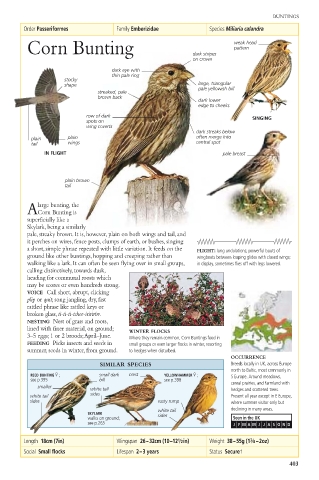
          large bunting, the
        ACorn Bunting is
        superficially like a
        Skylark, being a similarly
        pale, streaky brown. It is, however, plain on both wings and tail, and
        it perches on wires, fence posts, clumps of earth, or bushes, singing
        a short, simple phrase repeated with little variation. It feeds on the  FLIGHT: long undulations; powerful bouts of
        ground like other buntings, hopping and creeping rather than  wingbeats between looping glides with closed wings;
        walking like a lark. It can often be seen flying over in small groups,  in display, sometimes flies off with legs lowered.
        calling distinctively, towards dusk,
        heading for communal roosts which
        may be scores or even hundreds strong.
        VOICE Call short, abrupt, clicking
        plip or quit; song jangling, dry, fast
        rattled phrase like rattled keys or
        broken glass, ti-ti-ti-tchee-iriririrr.
        NESTING Nest of grass and roots,
        lined with finer material, on ground;  WINTER FLOCKS
        3–5 eggs; 1 or 2 broods;April–June.  Where they remain common, Corn Buntings feed in
        FEEDING Picks insects and seeds in  small groups or even larger flocks in winter, resorting
        summer, seeds in winter, from ground.  to hedges when disturbed.
                                                          OCCURRENCE
                          SIMILAR SPECIES                 Breeds locally in UK, across Europe
                                                          north to Baltic, most commonly in
         REED BUNTING 2;  small dark  crest  YELLOWHAMMER 2;  S Europe. Around meadows,
         see p.395        bill            see p.398
                                                          cereal prairies, and farmland with
          smaller
                       white tail                         hedges and scattered trees.
        white tail     sides                              Present all year except in E Europe,
        sides                           rusty rump        where summer visitor only but
                                        white tail        declining in many areas.
                       SKYLARK          sides
                       walks on ground;                    Seen in the UK
                       see p.265                           J  F  M  A  M  JJ A S O  N  D
       Length  18cm (7in)     Wingspan  26–32cm (10–12 1 ⁄2in)  Weight  38–55g (1 3 ⁄8 –2oz)
       Social  Small flocks   Lifespan  2–3 years    Status  Secure†
                                                                         403

