


Page 400 - Complete Birds of Britain and Europe (DK - RSPB)
P. 400
BUNTINGS
       Order Passeriformes    Family Emberizidae     Species Emberiza citrinella
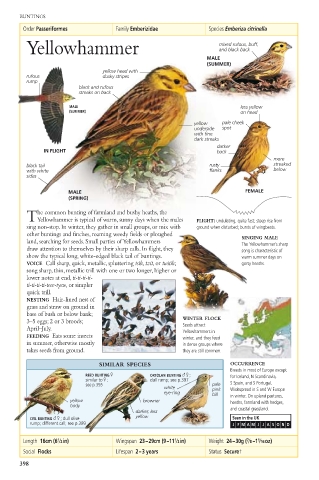
        Yellowhammer                                   mixed rufous, buff,
                                                       and black back
                                                    MALE
                                                    (SUMMER)
                           yellow head with
        rufous             dusky stripes
        rump
                     black and rufous
                     streaks on back
                  MALE                                       less yellow
                  (SUMMER)                                   on head
                                                 yellow  pale cheek
                                                 underside  spot
                                                 with fine
                                                 dark streaks
                                                       darker
            IN FLIGHT                                  back
                                                                     more
        black tail                                   rusty           streaked
        with white                                   flanks          below
        sides
                  MALE                                        FEMALE
                  (SPRING)
          he common bunting of farmland and bushy heaths, the
        TYellowhammer is typical of warm, sunny days when the males  FLIGHT: undulating, quite fast; steep rise from
        sing non-stop. In winter, they gather in small groups, or mix with  ground when disturbed; bursts of wingbeats.
        other buntings and finches, roaming weedy fields or ploughed  SINGING MALE
        land, searching for seeds. Small parties of Yellowhammers  The Yellowhammer’s sharp
        draw attention to themselves by their sharp calls. In flight, they  song is characteristic of
        show the typical long, white-edged black tail of buntings.  warm summer days on
        VOICE Call sharp, quick, metallic, spluttering tsik, tzit, or twitik;  gorsy heaths.
        song sharp, thin, metallic trill with one or two longer, higher or
        lower notes at end, ti-ti-ti-ti-
        ti-ti-ti-ti-teee-tyew, or simpler
        quick trill.
        NESTING Hair-lined nest of
        grass and straw on ground in
        base of bush or below bank;
        3–5 eggs; 2 or 3 broods;              WINTER FLOCK
                                              Seeds attract
        April–July.                           Yellowhammers in
        FEEDING Eats some insects             winter, and they feed
        in summer, otherwise mostly           in dense groups where
        takes seeds from ground.              they are still common.
                          SIMILAR SPECIES                 OCCURRENCE
                                                          Breeds in most of Europe except
                      REED BUNTING 2  ORTOLAN BUNTING 32;  for Iceland, N Scandinavia,
                      similar to 2;   dull rump; see p.397
                      see p.395                       pale  S Spain, and S Portugal.
                                          white       pink  Widespread in S and W Europe
                                          eye-ring    bill   in winter. On upland pastures,
                  yellow             browner              heaths, farmland with hedges,
                  body                                    and coastal grassland.
                                   darker, less
        CIRL BUNTING 32; dull olive  yellow                Seen in the UK
        rump; different call; see p.399                    J  F  M  A  M  JJ A S O  N  D
       Length  16cm (6 1 ⁄2in)  Wingspan  23–29cm (9–11 1 ⁄2in)  Weight  24–30g ( 7 ⁄8 –1 1 ⁄16oz)
       Social  Flocks         Lifespan  2–3 years    Status  Secure†
      398

