


Page 402 - Complete Birds of Britain and Europe (DK - RSPB)
P. 402
BUNTINGS
       Order Passeriformes    Family Emberizidae     Species Emberiza cia
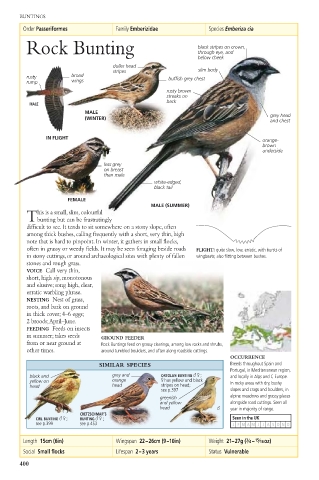
        Rock Bunting                              black stripes on crown,
                                                  through eye, and
                                                  below cheek
                             duller head
                             stripes              slim body
        rusty      broad                   buffish grey chest
        rump       wings
                                          rusty brown
                                          streaks on
                                          back
        MALE
                      MALE
                      (WINTER)                                      grey head
                                                                    and chest
             IN FLIGHT
                                                                  orange-
                                                                  brown
                                                                  underside
                           less grey
                           on breast
                           than male
                                       white-edged,
                                       black tail
                  FEMALE
                                      MALE (SUMMER)
          his is a small, slim, colourful
        Tbunting but can be frustratingly
        difficult to see. It tends to sit somewhere on a stony slope, often
        among thick bushes, calling frequently with a short, very thin, high
        note that is hard to pinpoint. In winter, it gathers in small flocks,
        often in grassy or weedy fields. It may be seen foraging beside roads  FLIGHT: quite slow, low, erratic, with bursts of
        in stony cuttings,or around archaeological sites with plenty of fallen  wingbeats; also flitting between bushes.
        stones and rough grass.
        VOICE Call very thin,
        short, high sip, monotonous
        and elusive; song high, clear,
        erratic warbling phrase.
        NESTING Nest of grass,
        roots, and bark on ground
        in thick cover; 4–6 eggs;
        2 broods;April–June.
        FEEDING Feeds on insects
        in summer; takes seeds   GROUND FEEDER
        from or near ground at   Rock Buntings feed on grassy clearings, among low rocks and shrubs,
        other times.      around tumbled boulders, and often along roadside cuttings.
                                                          OCCURRENCE
                          SIMILAR SPECIES                 Breeds throughout Spain and
                                                          Portugal, in Mediterranean region,
        black and            grey and    ORTOLAN BUNTING 32;  and locally in Alps and C Europe.
        yellow on            orange      2has yellow and black  In rocky areas with dry, bushy
        head                 head        stripes on head;
                                         see p.397        slopes and crags and boulders, in
                                                          alpine meadows and grassy places
                                         greenish
                                         and yellow       alongside road cuttings. Seen all
                                         head          3  year in majority of range.
                     CRETZSCHMAR’S
          CIRL BUNTING 32;  BUNTING 32;                    Seen in the UK
          see p.399  see p.453                             JF M A  M J  JA S ON D
       Length  15cm (6in)     Wingspan  22–26cm (9–10in)  Weight  21–27g ( 3 ⁄4 – 15 ⁄16oz)
       Social  Small flocks   Lifespan  2–3 years    Status  Vulnerable
      400

