


Page 404 - Complete Birds of Britain and Europe (DK - RSPB)
P. 404
BUNTINGS
       Order Passeriformes    Family Emberizidae     Species Calcarius lapponicus
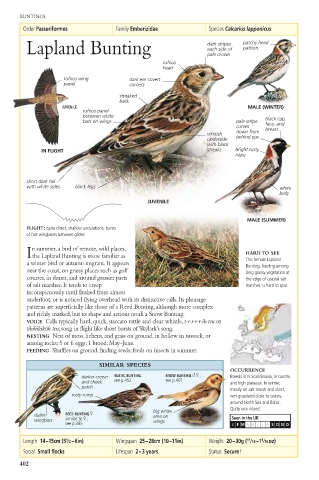
        Lapland Bunting                              dark stripes  patchy head
                                                             pattern
                                                     each side of
                                                     pale crown
                                         rufous
                                         head
                 rufous wing     dark ear covert
                 panel           corners
                               streaked
                               back
                JUVENILE                                       MALE (WINTER)
                      rufous panel
                      between white
                      bars on wings                         pale stripe   black cap,
                                                                   face, and
                                                            curves  breast
                                                    whitish  down from
                                                    underside  behind eye
                                                    with black
           IN FLIGHT                                streaks  bright rusty
                                                           nape
        short dark tail
        with white sides  black legs                                  white
                                                                      belly
                                      JUVENILE

                                                              MALE (SUMMER)
        FLIGHT: quite direct, shallow undulations; bursts
        of fast wingbeats between glides.
         n summer, a bird of remote, wild places,
        Ithe Lapland Bunting is more familiar as              HARD TO SEE
                                                              This female Lapland
        a winter bird or autumn migrant. It appears           Bunting, feeding among
        near the coast, on grassy places such as golf         long grassy vegetation at
        courses, in dunes, and around grassier parts          the edge of coastal salt
        of salt marshes. It tends to creep                    marshes, is hard to spot.
        inconspicuously until flushed from almost
        underfoot, or is noticed flying overhead with its distinctive calls. Its plumage
        patterns are superficially like those of a Reed Bunting, although more complex
        and richly marked, but its shape and actions recall a Snow Bunting.
        VOICE Calls typically hard, quick, staccato rattle and clear whistle, t-r-r-r-r-ik teu or
        tikikikiktik teu; song in flight like short bursts of Skylark’s song.
        NESTING Nest of moss, lichens, and grass on ground, in hollow in tussock, or
        among rocks; 5 or 6 eggs; 1 brood; May–June.
        FEEDING Shuffles on ground, finding seeds; feeds on insects in summer.
                          SIMILAR SPECIES
                                                          OCCURRENCE
                     darker crown  RUSTIC BUNTING  SNOW BUNTING 32;  Breeds in N Scandinavia, in tundra
                     and cheek  see p.452  see p.401      and high plateaux. In winter,
                     patch
                                                          mostly on salt marsh and short,
                   rusty rump                             wet grassland close to coasts,
                                                          around North Sea and Baltic.
                                                          Quite rare inland.
                                       big white
          duller  REED BUNTING 2       area on             Seen in the UK
          wingbars  similar to 2;      wings
                 see p.395                                 JF M A  M J  JA S ON D
       Length  14–15cm (5 1 ⁄2 –6in)  Wingspan  25–28cm (10–11in)  Weight  20–30g ( 11 ⁄16 –1 1 ⁄16oz)
       Social  Small flocks   Lifespan  2–3 years    Status  Secure†
      402

