


Page 403 - Complete Birds of Britain and Europe (DK - RSPB)
P. 403
BUNTINGS
       Order Passeriformes    Family Emberizidae     Species Plectrophenax nivalis
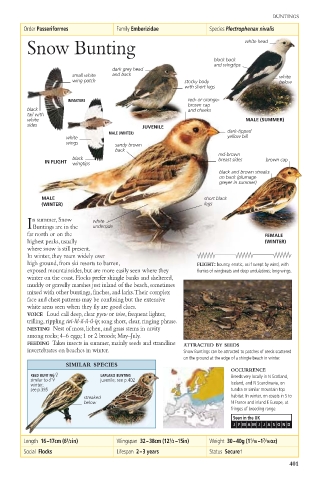
        Snow Bunting                                          white head

                                                      black back
                                                      and wingtips
                             dark grey head
                   small white  and back                              white
                   wing patch                  stocky body            below
                                               with short legs
                  IMMATURE                      red- or orange-
                                                brown cap
        black                                   and cheeks
        tail with
        white                                                 MALE (SUMMER)
        sides                       JUVENILE
                                                         dark-tipped
                            MALE (WINTER)
                 white                                   yellow bill
                 wings
                              sandy brown
                              back
                                                       red-brown
                   black                               breast sides  brown cap
            IN FLIGHT  wingtips
                                                       black and brown streaks
                                                       on back (plumage
                                                       greyer in summer)
           MALE                                     short black
           (WINTER)                                 legs
         n summer, Snow   white
        IBuntings are in the  underside
        far north or on the                                        FEMALE
        highest peaks, usually                                     (WINTER)
        where snow is still present.
        In winter, they roam widely over
        high ground, from ski resorts to barren,  FLIGHT: bouncy, erratic, as if swept by wind, with
        exposed mountainsides, but are more easily seen where they  flurries of wingbeats and deep undulations; long wings.
        winter on the coast. Flocks prefer shingle banks and sheltered,
        muddy or gravelly marshes just inland of the beach, sometimes
        mixed with other buntings, finches, and larks.Their complex
        face and chest patterns may be confusing but the extensive
        white areas seen when they fly are good clues.
        VOICE Loud call deep, clear pyew or tsioo, frequent lighter,
        trilling, rippling tiri-lil-il-il-il-ip; song short, clear, ringing phrase.
        NESTING Nest of moss, lichen, and grass stems in cavity
        among rocks; 4–6 eggs; 1 or 2 broods; May–July.
        FEEDING Takes insects in summer, mainly seeds and strandline  ATTRACTED BY SEEDS
        invertebrates on beaches in winter.    Snow Buntings can be attracted to patches of seeds scattered
                                               on the ground at the edge of a shingle beach in winter.
                 SIMILAR SPECIES
                                                          OCCURRENCE
         REED BUNTING 2   LAPLAND BUNTING                 Breeds very locally in N Scotland,
         similar to 32    juvenile; see p.402
         winter;                                          Iceland, and N Scandinavia, on
         see p.395                                        tundra or similar mountain top
                      streaked                            habitat. In winter, on coasts in S to
                      below                               N France and inland E Europe, at
                                                          fringes of breeding range.
                                                           Seen in the UK
                                                           J  F  M  A  M  JJ A S O  N  D
       Length  16–17cm (6 1 ⁄2in)  Wingspan  32–38cm (12 1 ⁄2 –15in)  Weight  30–40g (1 1 ⁄16 –1 7 ⁄16oz)
       Social  Flocks         Lifespan  2–3 years    Status  Secure†
                                                                         401

