


Page 455 - Complete Birds of Britain and Europe (DK - RSPB)
P. 455
BUNTINGS
       Family Emberizidae  Species Emberiza caesia  Family Emberizidae  Species Emberiza leucocephalus
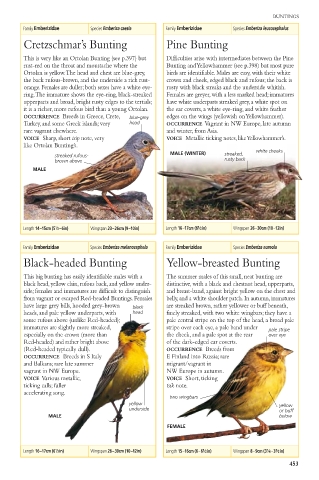
       Cretzschmar’s Bunting              Pine Bunting

       This is very like an Ortolan Bunting (see p.397) but  Difficulties arise with intermediates between the Pine
       rust-red on the throat and moustache where the  Bunting and Yellowhammer (see p.398) but most pure
       Ortolan is yellow.The head and chest are blue-grey,  birds are identifiable. Males are easy, with their white
       the back rufous-brown, and the underside a rich rust-  crown and cheek, edged black and rufous; the back is
       orange.Females are duller; both sexes have a white eye-  rusty with black streaks and the underside whitish.
       ring.The immature shows the eye-ring, black-streaked  Females are greyer, with a less marked head; immatures
       upperparts and broad, bright rusty edges to the tertials;  have white underparts streaked grey,a white spot on
       it is a richer, more rufous bird than a young Ortolan.  the ear coverts, a white eye-ring, and white feather
       OCCURRENCE Breeds in Greece, Crete,  blue-grey  edges on the wings (yellowish on Yellowhammer).
       Turkey, and some Greek islands; very  head  OCCURRENCE Vagrant in NW Europe, late autumn
       rare vagrant elsewhere.            and winter, from Asia.
       VOICE Sharp, short tsip note, very   VOICE Metallic ticking notes,like Yellowhammer’s.
       like Ortolan Bunting’s.
                                                                 white cheeks
               streaked rufous-            MALE (WINTER)  streaked,
               brown above                               rusty back
         MALE


       Length 14–15cm (5 1 ⁄2–6in)   Wingspan 23–26cm (9–10in)  Length 16–17cm (6 1 ⁄2in)   Wingspan 26–30cm (10–12in)

       Family Emberizidae  Species Emberiza melanocephala  Family Emberizidae  Species Emberiza aureola
       Black-headed Bunting               Yellow-breasted Bunting
       This big bunting has easily identifiable males with a  The summer males of this small, neat bunting are
       black head,yellow chin,rufous back,and yellow under-  distinctive, with a black and chestnut head, upperparts,
       side; females and immatures are difficult to distinguish  and breast-band, against bright yellow on the chest and
       from vagrant or escaped Red-headed Buntings.Females  belly,and a white shoulder patch.In autumn,immatures
       have large grey bills, hooded grey-brown  black  are streaked brown, rather yellower or buff beneath,
       heads, and pale yellow underparts, with  head  finely streaked, with two white wingbars; they have a
       some rufous above (unlike Red-headed);  pale central stripe on the top of the head, a broad pale
       immatures are slightly more streaked,  stripe over each eye, a pale band under
                                                                    pale stripe
       especially on the crown (more than  the cheek, and a pale spot at the rear  over eye
       Red-headed) and rather bright above  of the dark-edged ear coverts.
       (Red-headed typically dull).       OCCURRENCE Breeds from
       OCCURRENCE Breeds in S Italy       E Finland into Russia; rare
       and Balkans; rare late summer      migrant/vagrant in
       vagrant in NW Europe.              NW Europe in autumn.
       VOICE Various metallic,            VOICE Short, ticking
       ticking calls; fuller              tsik note.
       accelerating song.
                                           two wingbars
                                 yellow                               yellow
                                 underside                            or buff
             MALE                                                     below
                                           FEMALE


       Length 16–17cm (6 1 ⁄2in)   Wingspan 26–30cm (10–12in)  Length 15–16cm (6–6 1 ⁄2in)   Wingspan 8–9cm (3 1 ⁄4 –3 1 ⁄2in)
                                                                         453

