


Page 452 - Complete Birds of Britain and Europe (DK - RSPB)
P. 452
CROWS/STARLINGS/NORTH AMERICAN WARBLERS
       Family Corvidae  Species Perisoreus infaustus  Family Sturnidae  Species Sturnus roseus
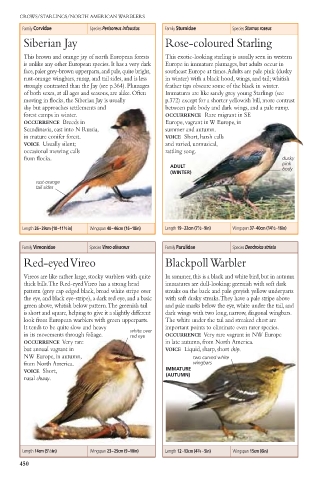
       Siberian Jay                       Rose-coloured Starling
       This brown and orange jay of north European forests  This exotic-looking starling is usually seen in western
       is unlike any other European species. It has a very dark  Europe in immature plumages, but adults occur in
       face,paler grey-brown upperparts,and pale,quite bright,  southeast Europe at times.Adults are pale pink (dusky
       rust-orange wingbars, rump, and tail sides, and is less  in winter) with a black hood, wings, and tail; whitish
       strongly contrasted than the Jay (see p.364). Plumages  feather tips obscure some of the black in winter.
       of both sexes, at all ages and seasons, are alike. Often  Immatures are like sandy grey young Starlings (see
       moving in flocks, the Siberian Jay is usually  p.372) except for a shorter yellowish bill, more contrast
       shy but approaches settlements and  between pale body and dark wings, and a pale rump.
       forest camps in winter.            OCCURRENCE Rare migrant in SE
       OCCURRENCE Breeds in               Europe, vagrant in W Europe, in
       Scandinavia, east into N Russia,   summer and autumn.
       in mature conifer forest.          VOICE Short, harsh calls
       VOICE Usually silent;              and varied, unmusical,
       occasional mewing calls            rattling song.
       from flocks.                                                    dusky
                                                                       pink
                                           ADULT                       body
                                           (WINTER)
          rust-orange
          tail sides


       Length 26–29cm (10–11 1 ⁄2in)  Wingspan 40–46cm (16–18in)  Length 19–22cm (7 1 ⁄2–9in)  Wingspan 37–40cm (14 1 ⁄2–16in)

       Family Vireonidae  Species Vireo olivaceus  Family Parulidae  Species Dendroica striata
       Red-eyed Vireo                     Blackpoll Warbler
       Vireos are like rather large, stocky warblers with quite  In summer,this is a black and white bird,but in autumn
       thick bills.The Red-eyed Vireo has a strong head  immatures are dull-looking: greenish with soft dark
       pattern (grey cap edged black, broad white stripe over  streaks on the back and pale greyish yellow underparts
       the eye,and black eye-stripe),a dark red eye,and a basic  with soft dusky streaks.They have a pale stripe above
       green above, whitish below pattern.The greenish tail  and pale marks below the eye, white under the tail, and
       is short and square,helping to give it a slightly different  dark wings with two long, narrow, diagonal wingbars.
       look from European warblers with green upperparts.  The white under the tail and streaked chest are
       It tends to be quite slow and heavy  important points to eliminate even rarer species.
                                 white over
       in its movements through foliage.  red eye  OCCURRENCE Very rare vagrant in NW Europe
       OCCURRENCE Very rare               in late autumn, from North America.
       but annual vagrant in              VOICE Liquid, sharp, short chip.
       NW Europe, in autumn,                     two curved white
       from North America.                       wingbars
       VOICE Short,                       IMMATURE
                                          (AUTUMN)
       nasal chway.


       Length 14cm (5 1 ⁄2in)   Wingspan 23–25cm (9–10in)  Length 12–13cm (4 3 ⁄4 –5in)   Wingspan 15cm (6in)
      450

