


Page 454 - Complete Birds of Britain and Europe (DK - RSPB)
P. 454
FINCHES/BUNTINGS
       Family Fringillidae  Species Pinicola enucleator  Family Fringillidae  Species Loxia scotica
       Pine Grosbeak                      Scottish Crossbill

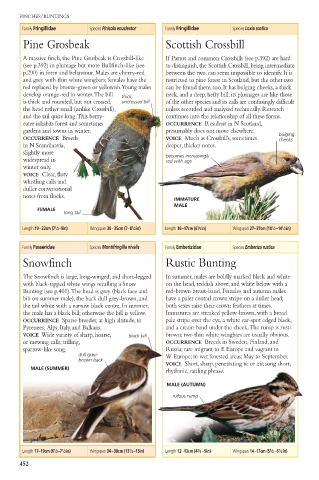
       A massive finch, the Pine Grosbeak is Crossbill-like  If Parrot and common Crossbills (see p.392) are hard
       (see p.392) in plumage but more Bullfinch-like (see  to distinguish,the Scottish Crossbill,being intermediate
       p.290) in form and behaviour. Males are cherry-red  between the two, can seem impossible to identify. It is
       and grey with thin white wingbars; females have the  restricted to pine forest in Scotland, but the other two
       red replaced by bronze-green or yellowish.Young males  can be found there, too. It has bulging cheeks, a thick
       develop orange-red in winter.The bill  neck, and a deep, hefty bill; its plumages are like those
                               thick,
       is thick and rounded, but not crossed,  uncrossed bill  of the other species and its calls are confusingly difficult
       the head rather small (unlike Crossbill),  unless recorded and analysed technically. Research
       and the tail quite long.This berry-  continues into the relationship of all these forms.
       eater inhabits forest and sometimes  OCCURRENCE Resident in N Scotland,
       gardens and towns in winter.       presumably does not move elsewhere.
       OCCURRENCE Breeds                  VOICE Much as Crossbill’s, sometimes   bulging
                                                                      cheeks
       in N Scandinavia,                  deeper, thicker notes.
       slightly more
                                          becomes increasingly
       widespread in                      red with age
       winter only.
       VOICE Clear, fluty
       whistling calls and
       duller conversational
       notes from flocks.
                                            IMMATURE
                                            MALE
          FEMALE
                 long tail
       Length 19–22cm (7 1 ⁄2–9in)   Wingspan 30–35cm (7–8 1 ⁄2in)  Length 16–17cm (6 1 ⁄2in)  Wingspan 27–37cm (10 1 ⁄2–14 1 ⁄2in)
       Family Passeridae  Species Montifringilla nivalis  Family Emberizidae  Species Emberiza rustica
       Snowfinch                          Rustic Bunting
       The Snowfinch is large, long-winged, and short-legged  In summer, males are boldly marked black and white
       with black-tipped white wings recalling a Snow  on the head, reddish above, and white below with a
       Bunting (see p.401).The head is grey (black face and  red-brown breast-band. Females and autumn males
       bib on summer male), the back dull grey-brown, and  have a paler central crown stripe on a duller head;
       the tail white with a narrow black centre. In summer,  both sexes raise their crown feathers at times.
       the male has a black bill; otherwise the bill is yellow.  Immatures are streaked yellow-brown, with a broad
       OCCURRENCE Sparse breeder, at high altitude, in  pale stripe over the eye, a white ear-spot edged black,
       Pyrenees, Alps, Italy, and Balkans.  and a cream band under the cheek.The rump is rust-
       VOICE Wide variety of sharp, hoarse,  black bill  brown; two thin white wingbars are usually obvious.
       or mewing calls; trilling,         OCCURRENCE Breeds in Sweden, Finland, and
       sparrow-like song.                 Russia; rare migrant to E Europe and vagrant in
                     dull grey-           W Europe; in wet forested areas; May to September.
                     brown back
                                          VOICE Short, sharp, penetrating tic or zit; song short,
         MALE (SUMMER)
                                          rhythmic, rattling phrase.
                                          MALE (AUTUMN)
                                            rufous rump


       Length 17–19cm (6 1 ⁄2–7 1 ⁄2in)   Wingspan 34–38cm (13 1 ⁄2–15in)  Length 12–13cm (4 3 ⁄4 –5in)   Wingspan 14–17cm (5 1 ⁄2 –6 1 ⁄2in)
      452

