


Page 451 - Complete Birds of Britain and Europe (DK - RSPB)
P. 451
NUTHATCHES/SHRIKES/CROWS
       Family Sittidae  Species Sitta neumayer  Family Laniidae  Species Lanius isabellinus
       Rock Nuthatch                      Isabelline Shrike

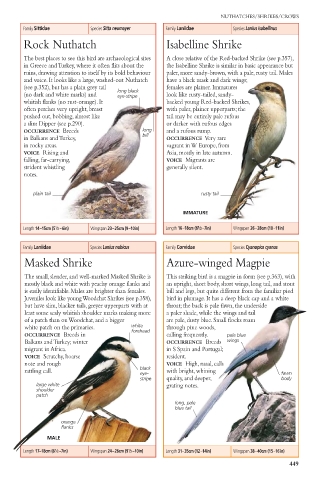
       The best places to see this bird are archaeological sites  A close relative of the Red-backed Shrike (see p.357),
       in Greece and Turkey, where it often flits about the  the Isabelline Shrike is similar in basic appearance but
       ruins, drawing attention to itself by its bold behaviour  paler, more sandy-brown, with a pale, rusty tail. Males
       and voice. It looks like a large, washed-out Nuthatch  have a black mask and dark wings;
       (see p.352), but has a plain grey tail   long black   females are plainer. Immatures
       (no dark and white marks) and  eye-stripe  look like rusty-tailed, sandy-
       whitish flanks (no rust-orange). It  backed young Red-backed Shrikes,
       often perches very upright, breast  with paler, plainer upperparts; the
       pushed out, bobbing, almost like   tail may be entirely pale rufous
       a slim Dipper (see p.290).         or darker with rufous edges
       OCCURRENCE Breeds            long  and a rufous rump.
       in Balkans and Turkey,       bill  OCCURRENCE Very rare
       in rocky areas.                    vagrant in W Europe, from
       VOICE Rising and                   Asia, mostly in late autumn.
       falling, far-carrying,             VOICE Migrants are
       strident whistling                 generally silent.
       notes.

         plain tail                                rusty tail

                                              IMMATURE
       Length 14–15cm (5 1 ⁄2 –6in)   Wingspan 23–25cm (9–10in)  Length 16–18cm (6 1 ⁄2 –7in)  Wingspan 26–28cm (10–11in)

       Family Laniidae  Species Lanius nubicus  Family Corvidae  Species Cyanopica cyanus
       Masked Shrike                      Azure-winged Magpie
       The small, slender, and well-marked Masked Shrike is  This striking bird is a magpie in form (see p.363), with
       mostly black and white with peachy orange flanks and  an upright, short body, short wings, long tail, and stout
       is easily identifiable.Males are brighter than females.  bill and legs, but quite different from the familiar pied
       Juveniles look like young Woodchat Shrikes (see p.358),  bird in plumage. It has a deep black cap and a white
       but have slim, blacker tails, greyer upperparts with at  throat; the back is pale fawn, the underside
       least some scaly whitish shoulder marks making more  a paler shade, while the wings and tail
       of a patch than on Woodchat, and a bigger   are pale, dusty blue. Small flocks roam
       white patch on the primaries.  white  through pine woods,
                                  forehead
       OCCURRENCE Breeds in               calling frequently.  pale blue
       Balkans and Turkey; winter         OCCURRENCE Breeds   wings
       migrant in Africa.                 in S Spain and Portugal;
       VOICE Scratchy, hoarse             resident.
       note and rough                     VOICE High, nasal, calls
                                    black
       rattling call.                     with bright, whining
                                    eye-                               fawn
                                    stripe  quality, and deeper,       body
          large white                     grating notes.
          shoulder
          patch
                                            long, pale
                                            blue tail
                orange
                flanks
             MALE
       Length 17–18cm (6 1 ⁄2 –7in)   Wingspan 24–26cm (9 1 ⁄2 –10in)  Length 31–35cm (12–14in)   Wingspan 38–40cm (15–16in)
                                                                         449

