


Page 453 - Complete Birds of Britain and Europe (DK - RSPB)
P. 453
NORTH AMERICAN WARBLERS/FINCHES
       Family Parulidae  Species Dendroica coronata  Family Fringillidae  Species  Carduelis hornemanni
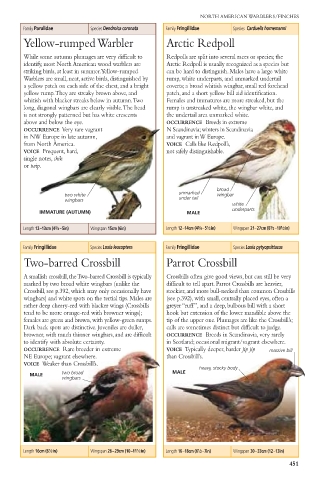
       Yellow-rumped Warbler              Arctic Redpoll
       While some autumn plumages are very difficult to  Redpolls are split into several races or species; the
       identify, most North American wood warblers are  Arctic Redpoll is usually recognized as a species but
       striking birds, at least in summer.Yellow-rumped  can be hard to distinguish. Males have a large white
       Warblers are small, neat, active birds, distinguished by   rump, white underparts, and unmarked undertail
       a yellow patch on each side of the chest, and a bright  coverts; a broad whitish wingbar, small red forehead
       yellow rump.They are streaky brown above, and  patch, and a short yellow bill aid identification.
       whitish with blacker streaks below in autumn.Two  Females and immatures are more streaked, but the
       long, diagonal wingbars are clearly visible.The head   rump is unstreaked white, the wingbar white, and
       is not strongly patterned but has white crescents   the undertail area unmarked white.
       above and below the eye.           OCCURRENCE Breeds in extreme
       OCCURRENCE Very rare vagrant       N Scandinavia;winters in Scandinavia
       in NW Europe in late autumn,       and vagrant in W Europe.
       from North America.                VOICE Calls like Redpoll’s,
       VOICE Frequent, hard,              not safely distinguishable.
       single notes, chik
       or twip.


                                                       broad
                                             unmarked
                 two white                             wingbar
                 wingbars                    under tail
                                                           white
                                                           underparts
           IMMATURE (AUTUMN)                   MALE
       Length 12–13cm (4 3 ⁄4 –5in)   Wingspan 15cm (6in)  Length 12–14cm (4 3 ⁄4 –5 1 ⁄2in)   Wingspan 21–27cm (8 1 ⁄2 –10 1 ⁄2in)
       Family Fringillidae  Species Loxia leucoptera  Family Fringillidae  Species Loxia pytyopsittacus
       Two-barred Crossbill               Parrot Crossbill
       A smallish crossbill,the Two-barred Crossbill is typically  Crossbills often give good views, but can still be very
       marked by two broad white wingbars (unlike the  difficult to tell apart. Parrot Crossbills are heavier,
       Crossbill, see p.392, which may only occasionally have  stockier,and more bull-necked than common Crossbills
       wingbars) and white spots on the tertial tips. Males are  (see p.392), with small, centrally placed eyes, often a
       rather deep cherry-red with blacker wings (Crossbills  greyer “ruff”, and a deep, bulbous bill with a short
       tend to be more orange-red with browner wings);  hook but extension of the lower mandible above the
       females are green and brown,with yellow-green rumps.  tip of the upper one. Plumages are like the Crossbill’s;
       Dark back spots are distinctive. Juveniles are duller,  calls are sometimes distinct but difficult to judge.
       browner, with much thinner wingbars, and are difficult  OCCURRENCE Breeds in Scandinavia, very rarely
       to identify with absolute certainty.  in Scotland; occasional migrant/vagrant elsewhere.
       OCCURRENCE Rare breeder in extreme  VOICE Typically deeper, harder jip jip  massive bill
       NE Europe; vagrant elsewhere.      than Crossbill’s.
       VOICE Weaker than Crossbill’s.
                                                  heavy, stocky body
                two broad                   MALE
        MALE
                wingbars


       Length 16cm (6 1 ⁄2in)  Wingspan 26–29cm (10–11 1 ⁄2in)  Length 16–18cm (6 1 ⁄2 –7in)   Wingspan 30–33cm (12–13in)
                                                                         451

