


Page 78 - Complete Birds of Britain and Europe (DK - RSPB)
P. 78
BITTERNS AND HERONS
       Order Ciconiiformes    Family Ardeidae        Species Ixobrychus minutus
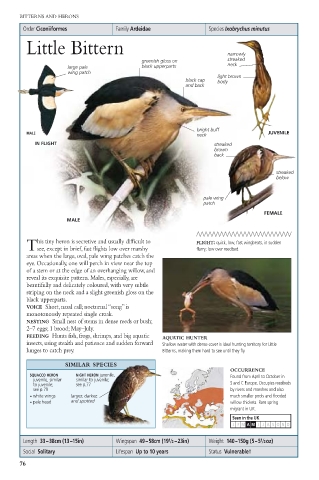
        Little Bittern                                    narrowly

                                    greenish gloss on     streaked
                  large pale        black upperparts      neck
                  wing patch
                                                       light brown
                                               black cap  body
                                               and back


                                                  bright buff
        MALE                                      neck              JUVENILE
          IN FLIGHT                                   streaked
                                                      brown
                                                      back
                                                                      streaked
                                                                      below

                                                    pale wing
                                                    patch
                                                                   FEMALE
                  MALE

          his tiny heron is secretive and usually difficult to  FLIGHT: quick, low, fast wingbeats, in sudden
        Tsee, except in brief, fast flights low over marshy  flurry; low over reedbed.
        areas when the large, oval, pale wing patches catch the
        eye. Occasionally, one will perch in view near the top
        of a stem or at the edge of an overhanging willow, and
        reveal its exquisite pattern. Males, especially, are
        beautifully and delicately coloured, with very subtle
        striping on the neck and a slight greenish gloss on the
        black upperparts.
        VOICE Short, nasal call; nocturnal “song” is
        monotonously repeated single croak.
        NESTING Small nest of stems in dense reeds or bush;
        2–7 eggs; 1 brood; May–July.
        FEEDING Hunts fish, frogs, shrimps, and big aquatic  AQUATIC HUNTER
        insects, using stealth and patience and sudden forward  Shallow water with dense cover is ideal hunting territory for Little
        lunges to catch prey.            Bitterns, making them hard to see until they fly.
                 SIMILAR SPECIES
                                                          OCCURRENCE
        SQUACCO HERON  NIGHT HERON juvenile,              Found from April to October in
         juvenile, similar   similar to juvenile;
         to juvenile;  see p.77                           S and C Europe. Occupies reedbeds
         see p.79                                         by rivers and marshes and also
          white wings  larger, darker,                    much smaller pools and flooded
          pale head  and spotted                          willow thickets. Rare spring
                                                          migrant in UK.
                                                           Seen in the UK
                                                           J  F  M  A  M  JJ A S O  N  D
       Length  33–38cm (13–15in)  Wingspan  49–58cm (19 1 ⁄2 –23in)  Weight  140–150g (5–5 1 ⁄2oz)
       Social  Solitary       Lifespan  Up to 10 years  Status  Vulnerable†
      76

