


Page 80 - Complete Birds of Britain and Europe (DK - RSPB)
P. 80
BITTERNS AND HERONS
       Order Ciconiiformes    Family Ardeidae        Species Bubulcus ibis
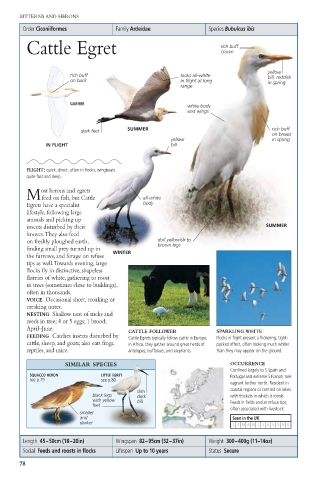
        Cattle Egret                                    rich buff
                                                        crown

                                                                    yellow
                  rich buff                   looks all-white       bill, reddish
                  on back                     in flight at long     in spring
                                              range
                  SUMMER
                                                white body
                                                and wings
                                 SUMMER                              rich buff
                     dark feet
                                                                     on breast
                                           yellow                    in spring
            IN FLIGHT                      bill
        FLIGHT: quick, direct, often in flocks; wingbeats
        quite fast and deep.
           ost herons and egrets
        Mfeed on fish, but Cattle    all-white
        Egrets have a specialist     body
        lifestyle, following large
        animals and picking up
        insects disturbed by their                                 SUMMER
        hooves.They also feed
        on freshly ploughed earth,      dull yellowish to
                                        brown legs
        finding small prey turned up in  WINTER
        the furrows, and forage on refuse
        tips as well.Towards evening, large
        flocks fly in distinctive, shapeless
        flurries of white, gathering to roost
        in trees (sometimes close to buildings),
        often in thousands.
        VOICE Occasional short, croaking or
        creaking notes.
        NESTING Shallow nest of sticks and
        reeds in tree; 4 or 5 eggs; 1 brood;
        April–June.              CATTLE FOLLOWER       SPARKLING WHITE
        FEEDING Catches insects disturbed by  Cattle Egrets typically follow cattle in Europe;  Flocks in flight present a flickering, tight-
        cattle, sheep, and goats; also eats frogs,  in Africa, they gather around great herds of  packed effect, often looking much whiter
        reptiles, and mice.      antelopes, buffaloes, and elephants.  than they may appear on the ground.
                 SIMILAR SPECIES                          OCCURRENCE
                                                          Confined largely to S Spain and
        SQUACCO HERON     LITTLE EGRET                    Portugal and extreme S France; rare
        see p.79          see p.80
                                                          vagrant farther north. Resident in
                                                          coastal regions or centred on lakes
                                   slim
                        black legs  dark                  with thickets in which it roosts.
                        with yellow  bill                 Feeds in fields and at refuse tips,
                        feet
                                                          often associated with livestock.
                     smaller
                     and                                   Seen in the UK
                     darker                                JF M A  M J  JA S ON D
       Length  45–50cm (18–20in)  Wingspan  82–95cm (32–37in)  Weight  300–400g (11–14oz)
       Social  Feeds and roosts in flocks  Lifespan  Up to 10 years  Status  Secure
      78

