


Page 79 - Complete Birds of Britain and Europe (DK - RSPB)
P. 79
BITTERNS AND HERONS
       Order Ciconiiformes    Family Ardeidae        Species Nycticorax nycticorax
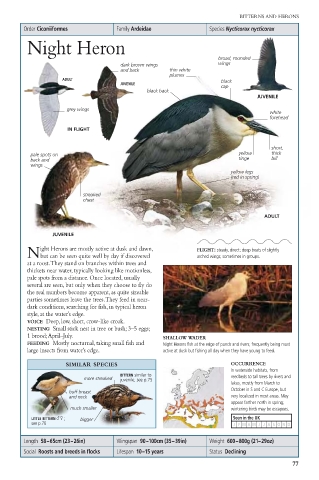
        Night Heron

                                                       broad, rounded
                               dark brown wings        wings
                               and back    thin white
                                           plumes
                 ADULT                                  black
                               JUVENILE
                                                        cap
                                      black back
                                                                 JUVENILE
                  grey wings
                                                                    white
                                                                    forehead
                  IN FLIGHT
                                                                    short,
         pale spots on                                      yellow  thick
         back and                                           tinge   bill
         wings
                                                          yellow legs
                                                          (red in spring)
                      streaked
                      chest
                                                                   ADULT

              JUVENILE
           ight Herons are mostly active at dusk and dawn,  FLIGHT: steady, direct; deep beats of slightly
        Nbut can be seen quite well by day if discovered   arched wings; sometimes in groups.
        at a roost.They stand on branches within trees and
        thickets near water, typically looking like motionless,
        pale spots from a distance. Once located, usually
        several are seen, but only when they choose to fly do
        the real numbers become apparent, as quite sizeable
        parties sometimes leave the trees.They feed in near-
        dark conditions, searching for fish, in typical heron
        style, at the water’s edge.
        VOICE Deep, low, short, crow-like croak.
        NESTING Small stick nest in tree or bush; 3–5 eggs;
        1 brood;April–July.               SHALLOW WADER
        FEEDING Mostly nocturnal, taking small fish and  Night Herons fish at the edge of ponds and rivers, frequently being most
        large insects from water’s edge.  active at dusk but fishing all day when they have young to feed.
                 SIMILAR SPECIES                          OCCURRENCE
                                                          In waterside habitats, from
                               BITTERN similar to         reedbeds to tall trees by rivers and
                      more streaked  juvenile; see p.75
                                                          lakes, mostly from March to
                                                          October in S and C Europe, but
                  buff breast
                  and neck                                very localized in most areas. May
                                                          appear farther north in spring;
                  much smaller                            wintering birds may be escapees.
         LITTLE BITTERN 32;  bigger                        Seen in the UK
         see p.76                                          J  F  M  A  M  JJ A S O  N  D
       Length  58–65cm (23–26in)  Wingspan  90–100cm (35–39in)  Weight  600–800g (21–29oz)
       Social  Roosts and breeds in flocks  Lifespan  10–15 years  Status  Declining
                                                                          77

