


Page 83 - Complete Birds of Britain and Europe (DK - RSPB)
P. 83
BITTERNS AND HERONS
       Order Ciconiiformes    Family Ardeidae        Species Egretta alba
        Great White Egret


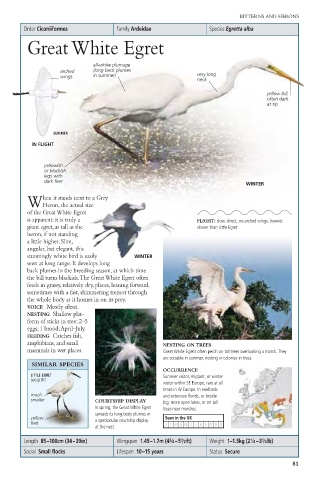
                        all-white plumage
                arched  (long back plumes
                wings   in summer)                very long
                                                  neck
                                                                   yellow bill,
                                                                   often dark
                                                                   at tip


              SUMMER
         IN FLIGHT

            yellowish
            or blackish
            legs with
            dark feet
                                                              WINTER
            hen it stands next to a Grey
        WHeron, the actual size
        of the Great White Egret
        is apparent: it is truly a                FLIGHT: slow, direct, on arched wings; heavier,
        giant egret, as tall as the               slower than Little Egret.
        heron, if not standing
        a little higher. Slim,
        angular, but elegant, this
        stunningly white bird is easily  WINTER
        seen at long range. It develops long
        back plumes in the breeding season, at which time
        the bill turns blackish.The Great White Egret often
        feeds in grassy, relatively dry, places, leaning forward,
        sometimes with a fast, shimmering tremor through
        the whole body as it homes in on its prey.
        VOICE Mostly silent.
        NESTING Shallow plat-
        form of sticks in tree; 2–5
        eggs; 1 brood;April–July.
        FEEDING Catches fish,
        amphibians, and small             NESTING ON TREES
        mammals in wet places.            Great White Egrets often perch on tall trees overlooking a marsh. They
                                          are sociable in summer, nesting in colonies in trees.
         SIMILAR SPECIES
                                          OCCURRENCE
         LITTLE EGRET                     Summer visitor, migrant, or winter
         see p.80
                                          visitor within SE Europe, rare at all
                                          times in W Europe. In reedbeds
         much                             and extensive floods, or beside
         smaller         COURTSHIP DISPLAY  big, more open lakes, or on tall
                         In spring, the Great White Egret  trees near marshes.
                         spreads its long body plumes in
         yellow          a spectacular courtship display   Seen in the UK
         feet                             JF M A  M J  JA S ON D
                         at the nest.
       Length  85–100cm (34–39in)  Wingspan  1.45–1.7m (4 3 ⁄4 –5 1 ⁄2ft)  Weight  1–1.5kg (2 1 ⁄4 –3 1 ⁄4lb)
       Social  Small flocks   Lifespan  10–15 years  Status  Secure
                                                                          81

