


Page 14 - Complete Birds of Britain and Europe (DK - RSPB)
P. 14
INTRODUCTION

        LIFE CYCLE

           bird’s appearance can vary significantly as   third summer, and so on (as illustrated here by the
        A a result of age or seasonal change. Newly  Black-headed Gull, whose sequence of plumages is
        hatched, chicks may be naked or downy. The  related to the seasons).There are variations on the
        down is quickly replaced by a first set of feathers, theme. For example, while most birds have their
        called the juvenile plumage. In autumn, some   brightest plumage in summer, wildfowl are at their
        of these feathers are moulted and replaced (the  best while pairing up in midwinter; the males
        wing and tail feathers are usually retained) to  become dull in summer, in an “eclipse” plumage.
        produce a first winter plumage. In the following
        spring, a partial moult produces the first summer
        plumage. From late summer onwards, all the                      MARCH
        feathers are replaced in a complete moult.Smaller
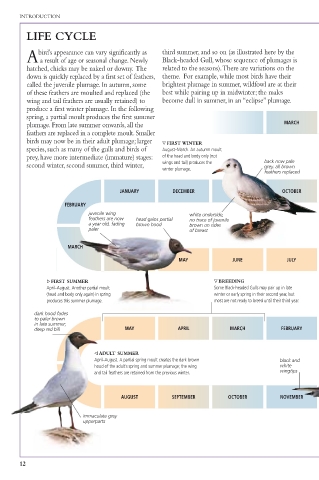
        birds may now be in their adult plumage; larger  1  FIRST WINTER
        species, such as many of the gulls and birds of  August–March. An autumn moult
        prey, have more intermediate (immature) stages:  of the head and body only (not  back now pale
        second winter, second summer, third winter,  wings and tail) produces the  grey, all brown
                                         winter plumage.
                                                                   feathers replaced
                               JANUARY      DECEMBER                   OCTOBER
                 FEBRUARY
                       juvenile wing            white underside,
                       feathers are now   head gains partial  no trace of juvenile
                       a year old, fading  brown hood  brown on sides
                       paler                    of breast
                  MARCH
                                             MAY           JUNE         JULY

              FIRST SUMMER                             1  BREEDING
             1
             April–August. Another partial moult      Some Black-headed Gulls may pair up in late
             (head and body only again) in spring     winter or early spring in their second year, but
             produces this summer plumage.            most are not ready to breed until their third year.
          dark hood fades
          to paler brown
          in late summer;
          deep red bill         MAY          APRIL        MARCH        FEBRUARY

                         1  ADULT SUMMER
                        April–August. A partial spring moult creates the dark brown  black and
                        hood of the adult’s spring and summer plumage; the wing  white
                        and tail feathers are retained from the previous winter.   wingtips


                               AUGUST       SEPTEMBER     OCTOBER      NOVEMBER

                      immaculate grey
                      upperparts


      12

