


Page 32 - (DK Eyewitness) Travel Guide - Spain
P. 32
30 INTRODUCING SP AIN
Vernacular Architecture
As well as its cathedrals and palaces, Spain has a great
variety of charming vernacular buildings. These have
been constructed by local craftsmen to meet the practical
needs of rural communities and to take account of local
climate conditions, with little reference to formal archi
tectural styles. Due to the high expense involved in
transporting raw materials, builders used whatever stone
or timber lay closest to hand. The three houses illustrated
below incorporate the most common characteristics of A cave church in Artenara (see p549), on
village architecture seen in different parts of Spain. Gran Canaria
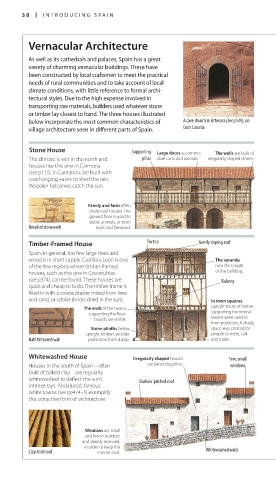
Stone House Supporting Large doors accommo- The walls are built of
The climate is wet in the north and pillar date carts and animals. irregularly shaped stones.
houses like this one in Carmona
(see p115), in Cantabria, are built with
overhanging eaves to shed the rain.
Wooden balconies catch the sun.
Family and farm often
share rural houses. The
ground floor is used to
stable animals, or store
Detail of stonework tools and firewood.
Timber-Framed House Portico Gently sloping roof
Spain, in general, has few large trees and
wood is in short supply. Castilla y León is one The veranda
of the few regions where timber-framed runs the length
houses, such as this one in Covarrubias of the building.
(see p374), can be found. These houses are Balcony
quick and cheap to build. The timber frame is
filled in with a coarse plaster mixed from lime
and sand, or adobe (bricks dried in the sun). In town squares,
The ends of the beams upright struts of timber
supporting the floor- supporting horizontal
boards are visible. beams were used to
form porticoes. A shady
Stone plinths below space was created for
upright timbers provide people to meet, talk
Half-timbered wall protection from damp. and trade.
Whitewashed House Irregularly shaped houses Few, small
Houses in the south of Spain – often are joined together. windows
built of baked clay – are regularly
whitewashed to deflect the sun’s Shallow-pitched roof
intense rays. Andalucía’s famous
white towns (see pp474–5) exemplify
this attractive form of architecture.
Windows are small
and few in number,
and deeply recessed,
in order to keep the
Clay-tiled roof interior cool. Whitewashed walls
030-031_EW_Spain.indd 30 26/09/17 11:52 am

