


Page 33 - (DK Eyewitness) Travel Guide - Spain
P. 33
A POR TR AIT OF SP AIN 31
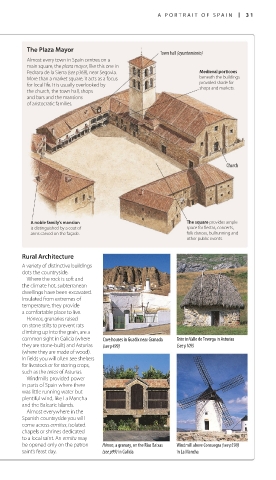
The Plaza Mayor
Town hall (ayuntamiento)
Almost every town in Spain centres on a
main square, the plaza mayor, like this one in
Pedraza de la Sierra (see p369), near Segovia. Medieval porticoes
More than a market square, it acts as a focus beneath the buildings
for local life. It is usually overlooked by provided shade for
shops and markets.
the church, the town hall, shops
and bars and the mansions
of aristocratic families.
Church
A noble family’s mansion The square provides ample
is distinguished by a coat of space for fiestas, concerts,
arms carved on the façade. folk dances, bullrunning and
other public events.
Rural Architecture
A variety of distinctive build ings
dots the countryside.
Where the rock is soft and
the climate hot, subterranean
dwellings have been excavat ed.
Insulated from extremes of
temperature, they provide
a comfortable place to live.
Hórreos, granaries raised
on stone stilts to prevent rats
climbing up into the grain, are a
common sight in Galicia (where Cave houses in Guadix near Granada Teito in Valle de Teverga in Asturias
they are stone-built) and Asturias (see p499) (see p109)
(where they are made of wood).
In fields you will often see shelters
for live stock or for storing crops,
such as the teitos of Asturias.
Windmills provided power
in parts of Spain where there
was little running water but
plentiful wind, like La Mancha
and the Balearic Islands.
Almost everywhere in the
Spanish countryside you will
come across ermitas, isolated
chapels or shrines dedicated
to a local saint. An ermita may
be opened only on the patron Hórreo, a granary, on the Rías Baixas Windmill above Consuegra (see p398)
saint’s feast day. (see p99) in Galicia in La Mancha
030-031_EW_Spain.indd 31 26/09/17 11:52 am

