


Page 99 - (DK) Smithsinian - Military History: The Definitive Visual Guide to the Objects of Warfare
P. 99
97

                                                                                                          ◀ A SAMURAI RITUAL
            warrior-clans with regional power bases. In the                                               BEHEADING
            12th-century Gempei Wars, the Minamoto and                                                    It was the custom in medieval Japan
            Taira clans fought, the Minamoto emerging as                                                  for a samurai killed in combat to
            military rulers of Japan—the shoguns.                                                         be beheaded by his enemies. The
              In this period, the samurai were primarily                                                  severed head was then returned to his   EAST ASIAN  W
                                                                                                          relatives, mounted on a spiked board.
            mounted bowmen; the art of Japanese sword-
            making only evolved in the late middle ages.
            Samurai warfare was highly stylized: battles
            opened with archery duels between notable
            warriors, and defeat led to ritual suicide (hara-                                                                           ARF
            kiri). Nevertheless, when Kublai Khan tried to
            invade Japan by sea, in 1274 and 1281, he found                                                                             ARE
            them to be formidable foes: the Mongols were
            repulsed, albeit with help from the bad weather
            that wrecked the invasion fleets.


            “They come with the swiftness of lightning, ravaging

            and slaughtering, striking everyone with terror and

            with incomparable horror”


                                          ENGLISH MONK MATTHEW PARIS, DESCRIBING THE MONGOLS, c.1250

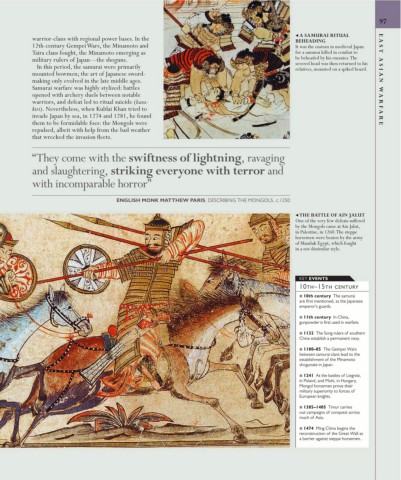
                                                                                                          ◀ THE BATTLE OF AIN JALUT
                                                                                                          One of the very few defeats suffered
                                                                                                          by the Mongols came at Ain Jalut,
                                                                                                          in Palestine, in 1260. The steppe
                                                                                                          horsemen were beaten by the army
                                                                                                          of Mamluk Egypt, which fought
                                                                                                          in a not dissimilar style.


                                                                                                            KEY EVENTS
                                                                                                            10th–15th century
                                                                                                            ◼ 10th century  The samurai
                                                                                                            are first mentioned, as the Japanese
                                                                                                            emperor’s guards.
                                                                                                            ◼ 11th century  In China,
                                                                                                            gunpowder is first used in warfare.

                                                                                                            ◼ 1132  The Song rulers of southern
                                                                                                            China establish a permanent navy.
                                                                                                            ◼ 1180–85  The Gempei Wars
                                                                                                            between samurai clans lead to the
                                                                                                            establishment of the Minamoto
                                                                                                            shogunate in Japan.
                                                                                                            ◼ 1241  At the battles of Liegnitz,
                                                                                                            in Poland, and Mohi, in Hungary,
                                                                                                            Mongol horsemen prove their
                                                                                                            military superiority to forces of
                                                                                                            European knights.
                                                                                                            ◼ 1385–1405  Timur carries
                                                                                                            out campaigns of conquest across
                                                                                                            much of Asia.

                                                                                                            ◼ 1474  Ming China begins the
                                                                                                            reconstruction of the Great Wall as
                                                                                                            a barrier against steppe horsemen.

