


Page 98 - (DK) Smithsinian - Military History: The Definitive Visual Guide to the Objects of Warfare
P. 98
96      KEY FIGURE                 KEY DEVELOPMENT

         WMEN 500–1500  GHENGHIS KHAN    EAST ASIAN WARFARE

              1162–1227

              Originally named Temujin, the
              founder of the Mongol Empire
                                         Three distinct approaches to weapons and warfare evolved in medieval
              took the title Genghis Khan after
              uniting the steppe tribes in 1206.
                                         East Asia. While steppe tribesmen depended upon horses and the compound
              By the time of his death, his
                                         bow, and China combined advanced technology with mass peasant armies,
              horsemen had campaigned as far
              begun the conquest of China.
                                         of the samurai warrior.
         AND BO  west as the Black Sea coast and   the Japanese, developed the idiosyncratic, highly ritualized fighting style
                                                                                        could not hold out against the Mongol forces of
                                         Under the dynasties of the Tang (618–907ce) and
                                         the Song (960–1279), China was the world leader   Kublai Khan, however, who created his own fleet
                                         in technological innovation. However, defending its  to conquer southern China in 1279, and later
         KNIGHTS                         long frontier from bow-armed nomadic horsemen   sailed to Japan and Java, a tradition continued by
                                         often overwhelmed the country’s military resources.  the next native Chinese dynasty, the Ming (1368–
                                          The Song fielded large armies of conscripted foot  1644). From 1405 to 1433, the eunuch admiral
                                                                                        Zheng He led the Ming fleet to East Africa. But he
                                         soldiers. Although most were equipped with basic
                                         staff weapons, such as the halberd, they also used an  soon turned his attention to defending the steppe
                                         impressive array of crossbows, ranging from simple,  frontier, diverting resources to build the Great Wall.
                                         hand-held bows to large, lever-operated repeating   Meanwhile, a distinctive military culture had
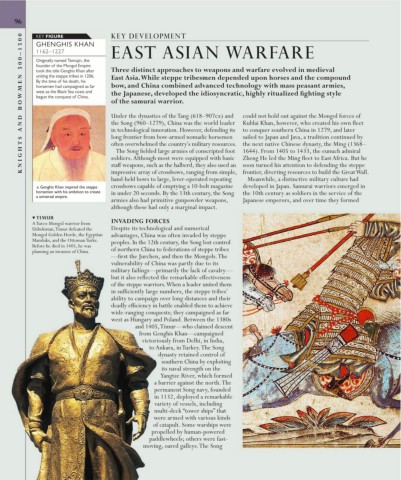
              ▲ Genghis Khan inspired the steppe   crossbows capable of emptying a 10-bolt magazine   developed in Japan. Samurai warriors emerged in
              horsemen with his ambition to create   in under 20 seconds. By the 13th century, the Song   the 10th century as soldiers in the service of the
              a universal empire.
                                         armies also had primitive gunpowder weapons,   Japanese emperors, and over time they formed
                                         although these had only a marginal impact.

            ▼ TIMUR
            A Turco-Mongol warrior from   INVADING FORCES
            Uzbekistan, Timur defeated the   Despite its technological and numerical
            Mongol Golden Horde, the Egyptian   advantages, China was often invaded by steppe
            Mamluks, and the Ottoman Turks.   peoples. In the 12th century, the Song lost control
            Before he died in 1405, he was   of northern China to federations of steppe tribes
            planning an invasion of China.
                                         —first the Jurchen, and then the Mongols. The
                                         vulnerability of China was partly due to its
                                         military failings—primarily the lack of cavalry—
                                         but it also reflected the remarkable effectiveness
                                         of the steppe warriors. When a leader united them
                                         in sufficiently large numbers, the steppe tribes’
                                         ability to campaign over long distances and their
                                         deadly efficiency in battle enabled them to achieve
                                         wide-ranging conquests; they campaigned as far
                                         west as Hungary and Poland. Between the 1380s
                                                 and 1405, Timur—who claimed descent
                                                   from Genghis Khan—campaigned
                                                    victoriously from Delhi, in India,
                                                      to Ankara, in Turkey. The Song
                                                         dynasty retained control of
                                                           southern China by exploiting
                                                           its naval strength on the
                                                          Yangtze River, which formed
                                                        a barrier against the north. The
                                                        permanent Song navy, founded
                                                        in 1132, deployed a remarkable
                                                        variety of vessels, including
                                                        multi-deck “tower ships” that
                                                        were armed with various kinds
                                                        of catapult. Some warships were
                                                       propelled by human-powered
                                                      paddlewheels; others were fast-
                                                    moving, oared galleys. The Song

