


Page 96 - (DK) Smithsinian - Military History: The Definitive Visual Guide to the Objects of Warfare
P. 96
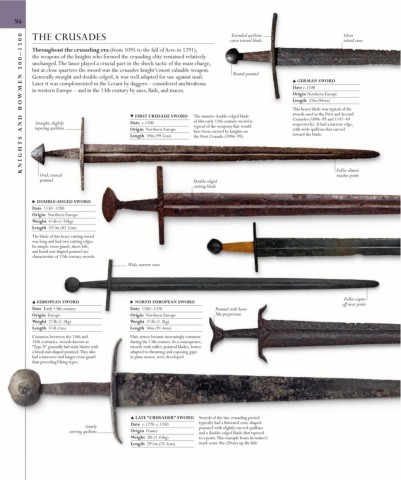
94    THE CRUSADES                                                           curve toward blade                      Silver

                                                                                    Extended quillons
         WMEN 500–1500  Throughout the crusading era (from 1095 to the fall of Acre in 1291),   Round pommel  ▲ GERMAN SWORD
                                                                                                                           inlaid cross

            the weapons of the knights who formed the crusading elite remained relatively
            unchanged. The lance played a crucial part in the shock tactic of the mass charge,
            but at close quarters the sword was the crusader knight’s most valuable weapon.
            Generally straight and double-edged, it was well adapted for use against mail.
            Later it was complemented in the Levant by daggers—considered unchivalrous
                                                                                                         Date c.1100
            in western Europe—and in the 13th century by axes, flails, and maces.
                                                                                                         Length  37in (94cm)
         AND BO  tapering quillons             ▼ FIRST CRUSADE SWORD  The massive double-edged blade     Origin Northern Europe
                                                                                                         This heavy blade was typical of the
                                                                                                         swords used in the First and Second
                                                                                                         Crusades (1096–99 and 1147–49
                                                                      of this early 12th-century sword is
                                               Date  c.1100
             Straight, slightly
                                                                                                         respectively). It had a narrow edge,
                                                                      typical of the weapons that would
                                               Origin  Northern Europe
                                                                                                         with wide quillons that curved
                                                                      have been carried by knights on
                                                                                                         toward the blade.
         KNIGHTS                               Length  39in (99.5cm)  the First Crusade (1096–99).
               Oval, conical                                                                                             Fuller almost
                                                                                                                         reaches point
               pommel                                                 Double-edged
                                                                      cutting blade

            ▶ DOUBLE-EDGED SWORD
            Date  1150 –1200
            Origin  Northern Europe
                   1
            Weight  4 ⁄4lb (1.95kg)
                    1
            Length  32 ⁄4in (82.2cm)
            The blade of this heavy cutting sword
            was long and had two cutting edges.
            Its simple cross-guard, short hilt,
            and brazil-nut-shaped pommel are
            characteristic of 12th-century swords.
                                               Wide, narrow cross


                                                                                                                            Fuller tapers
            ▲ EUROPEAN SWORD                   ▶ NORTH EUROPEAN SWORD
                                                                                                                           off near point
            Date  Early 13th century           Date  1280 –1320               Pommel with horn-
            Origin  Europe                     Origin  Northern Europe        like projections
            Weight  2 ⁄2lb (1.2kg)             Weight  2 ⁄2lb (1.2kg)
                                                      1
                   1
                   1
            Length  3 ⁄4ft (1m)                Length  36in (91.4cm)
            Common between the 10th and        Plate armor became increasingly common
            14th centuries, swords known as     during the 13th century. As a consequence,
            “Type X” generally had wide blades with    swords with stiffer, pointed blades, better
            a brazil-nut-shaped pommel. They also    adapted to thrusting and exposing gaps
            had a narrower and longer cross-guard    in plate armor, were developed.
            than preceding Viking types.


                                                ▲ LATE “CRUSADER” SWORD  Swords of the late crusading period
                                                Date  c.1270–c.1350     typically had a flattened cone-shaped
                               Gently                                   pommel with slightly curved quillons
                          curving quillons      Origin  France          and a double-edged blade that tapered
                                                Weight  3lb (1.45kg)    to a point. This example bears its maker’s
                                                       1
                                                Length  29 ⁄4in (74.5cm)  mark some 8in (20cm) up the hilt.

