


Page 123 - (DK) Smithsinian - Military History: The Definitive Visual Guide to the Objects of Warfare
P. 123
121
Quillon
Pommel EUR
Ricasso
Ring guard OPEAN
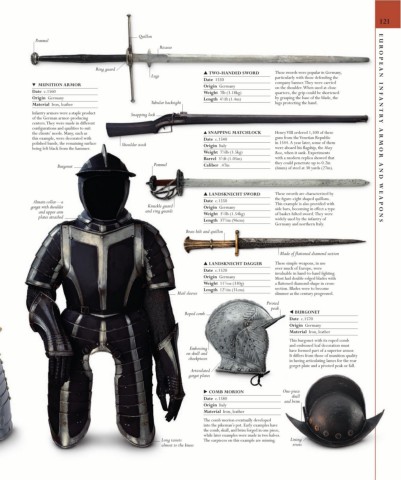
▲ TWO-HANDED SWORD These swords were popular in Germany,
Lugs particularly with those defending the
Date 1550
▼ MUNITION ARMOR Origin Germany company banner. They were carried
on the shoulder. When used at close
Date c.1560 Weight 7lb (3.18kg) quarters, the grip could be shortened INF
Origin Germany Length 4 ⁄2ft (1.4m) by grasping the base of the blade, the
1
Material Iron, leather Tubular backsight lugs protecting the hand. ANTR
Infantry armors were a staple product Snapping lock
of the German armor-producing
centers. They were made in different
configurations and qualities to suit
the clients’ needs. Many, such as ▲ SNAPPING MATCHLOCK Henry VIII ordered 1,500 of these
this example, were decorated with Date c.1540 guns from the Venetian Republic
polished bands, the remaining surface Shoulder stock Origin Italy in 1544. A year later, some of them
being left black from the hammer. were aboard his flagship, the Mary
Weight 7 ⁄4lb (3.5kg) Rose, when it sank. Experiments
3
1
Barrel 3 ⁄2ft (1.05m) with a modern replica showed that
they could penetrate up to 0.2in
Burgonet Pommel Caliber .47in (6mm) of steel at 30 yards (27m). Y ARMOR AND WEAPONS
▲ LANDSKNECHT SWORD These swords are characterized by
the figure-eight shaped quillons.
Almain collar—a Date c.1550 This example is also provided with
gorget with shoulder Knuckle guard Origin Germany side bars, becoming in effect a type
and upper arm and ring guards Weight 3 ⁄2lb (1.54kg) of basket-hilted sword. They were
1
plates attached widely used by the infantry of
3
Length 37 ⁄4in (96cm)
Germany and northern Italy.
Brass hilt and quillon
Blade of flattened diamond section
▲ LANDSKNECHT DAGGER These simple weapons, in use
over much of Europe, were
Date c.1520
invaluable in hand-to-hand fighting.
Origin Germany Most had double-edged blades with
1
Weight 11 ⁄4oz (330g) a flattened diamond-shape in cross-
1
Length 12 ⁄4in (31cm) section. Blades were to become
Mail sleeves slimmer as the century progressed.
Pivoted
peak
Roped comb ◀ BURGONET
Date c.1570
Origin Germany
Material Iron, leather
This burgonet with its roped comb
and embossed leaf decoration must
Embossing have formed part of a superior armor.
on skull and It differs from those of munition quality
cheekpieces
in having articulating lames for the rear
gorget plate and a pivoted peak or fall.
Articulated
gorget plates
▶ COMB MORION One-piece
skull
Date c.1580
and brim
Origin Italy
Material Iron, leather
The comb morion eventually developed
into the pikeman’s pot. Early examples have
the comb, skull, and brim forged in one piece,
while later examples were made in two halves.
Long tassets The earpieces on this example are missing. Lining
almost to the knees rivets

