


Page 122 - (DK) Smithsinian - Military History: The Definitive Visual Guide to the Objects of Warfare
P. 122
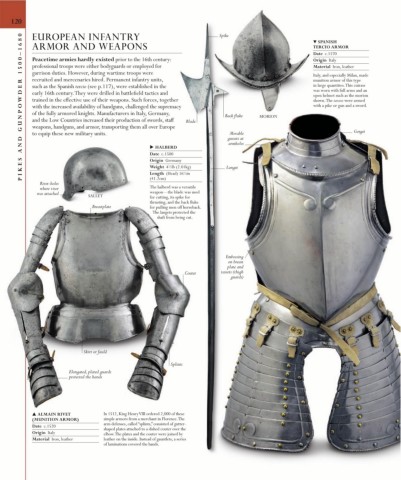
120    EUROPEAN INFANTRY                                                  Spike                             ▼ SPANISH

         WDER 1500–1680  ARMOR AND WEAPONS                                                                       TERCIO ARMOR


                                                                                                                 Date  c.1570
            Peacetime armies hardly existed prior to the 16th century:
                                                                                                                 Origin  Italy
            professional troops were either bodyguards or employed for
                                                                                                                 Material  Iron, leather
            garrison duties. However, during wartime troops were
                                                                                                                 Italy, and especially Milan, made
            recruited and mercenaries hired. Permanent infantry units,
                                                                                                                 munition armor of this type
                                                                                                                 in large quantities. This cuirass
            such as the Spanish tercio (see p.117), were established in the
                                                                                                                 was worn with full arms and an
            early 16th century. They were drilled in battlefield tactics and
                                                                                                                 open helmet such as the morion
                                                                                                                 with a pike or gun and a sword.
         AND GUNPO  trained in the effective use of their weapons. Such forces, together   Blade  Back fluke  MORION  shown. The tercios were armed
            with the increased availability of handguns, challenged the supremacy
            of the fully armored knights. Manufacturers in Italy, Germany,
            and the Low Countries increased their production of swords, staff
            weapons, handguns, and armor, transporting them all over Europe
                                                                                                                               Gorget
            to equip these new military units.
                                                                                   Movable
                                                                                  gussets at
                                                                                  armholes
                                                      ▶ HALBERD
         PIKES                                        Date  c.1500  1             Langet
                                                      Origin  Germany
                                                             1
                                                      Weight  4 ⁄2lb (2.01kg)
                                                      Length  (Head) 16 ⁄4in
               Rivet-holes                            (41.2cm)
               where visor                            The halberd was a versatile
              was attached                            weapon—the blade was used
                                SALLET                for cutting, its spike for
                                                      thrusting, and the back fluke
                                  Breastplate         for pulling men off horseback.
                                                       The langets protected the
                                                         shaft from being cut.


                                                                                 Embossing
                                                                                  on breast
                                                                                  plate and
                                                                   Couter       tassets (thigh
                                                                                   guards)


                               Skirt or fauld

                                                              Splints
                         Elongated, plated guards
                         protected the hands


            ▲ ALMAIN RIVET            In 1512, King Henry VIII ordered 2,000 of these
            (MUNITION ARMOR)          simple armors from a merchant in Florence. The
                                      arm defenses, called “splints,” consisted of gutter-
            Date  c.1520
                                      shaped plates attached to a dished couter over the
            Origin  Italy             elbow. The plates and the couter were joined by
            Material  Iron, leather   leather on the inside. Instead of gauntlets, a series
                                      of laminations covered the hands.

