


Page 127 - (DK) Smithsinian - Military History: The Definitive Visual Guide to the Objects of Warfare
P. 127
125

                                                               PIKE AND MATCHLOCK MUSKET
                                                               THE BATTLE OF                                                            THE BA


                                                               WHITE MOUNTAIN


                                                               In the Thirty Years’ War, fought in central Europe between
                                                               1618 and 1648, all armies used infantry armed with pikes
                                                               and matchlock muskets. This distinctive form of warfare is
                                                               exemplified by the Battle of  White Mountain, an important
                                                               encounter in the opening phase of the conflict.                          TTLE OF  WHITE MOUNT


                                                               The Battle of  White Mountain       A SHORT ENGAGEMENT
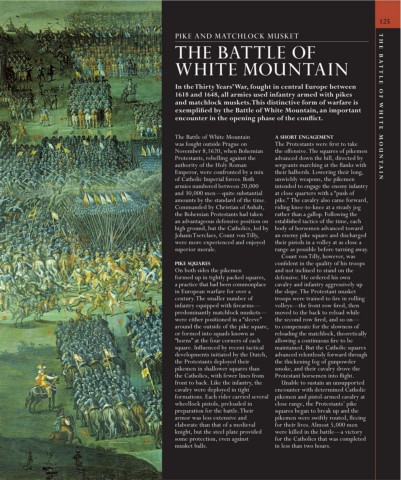
                                                               was fought outside Prague on        The Protestants were first to take
                                                               November 8,1620, when Bohemian      the offensive. The squares of pikemen
                                                               Protestants, rebelling against the   advanced down the hill, directed by
                                                               authority of the Holy Roman         sergeants marching at the flanks with
                                                               Emperor, were confronted by a mix   their halberds. Lowering their long,   AIN
                                                               of Catholic Imperial forces. Both   unwieldy weapons, the pikemen
                                                               armies numbered between 20,000      intended to engage the enemy infantry
                                                               and 30,000 men—quite substantial    at close quarters with a “push of
                                                               amounts by the standard of the time.   pike.”  The cavalry also came forward,
                                                               Commanded by Christian of Anhalt,   riding knee-to-knee at a steady jog
                                                               the Bohemian Protestants had taken   rather than a gallop. Following the
                                                               an advantageous defensive position on  established tactics of the time, each
                                                               high ground, but the Catholics, led by  body of horsemen advanced toward
                                                               Johann Tserclaes, Count von Tilly,   an enemy pike square and discharged
                                                               were more experienced and enjoyed   their pistols in a volley at as close a
                                                               superior morale.                    range as possible before turning away.
                                                                                                     Count von Tilly, however, was
                                                               PIKE SQUARES                        confident in the quality of his troops
                                                               On both sides the pikemen           and not inclined to stand on the
                                                               formed up in tightly packed squares,   defensive. He ordered his own
                                                               a practice that had been commonplace   cavalry and infantry aggressively up
                                                               in European warfare for over a      the slope. The Protestant musket
                                                               century. The smaller number of      troops were trained to fire in rolling
                                                               infantry equipped with firearms—    volleys—the front row fired, then
                                                               predominantly matchlock muskets—    moved to the back to reload while
                                                               were either positioned in a “sleeve”   the second row fired, and so on—
                                                               around the outside of the pike square,  to compensate for the slowness of
                                                               or formed into squads known as      reloading the matchlock, theoretically
                                                               “horns” at the four corners of each   allowing a continuous fire to be
                                                               square. Influenced by recent tactical   maintained. But the Catholic squares
                                                               developments initiated by the Dutch,  advanced relentlessly forward through
                                                               the Protestants deployed their      the thickening fog of gunpowder
                                                               pikemen in shallower squares than   smoke, and their cavalry drove the
                                                               the Catholics, with fewer lines from   Protestant horsemen into flight.
                                                               front to back. Like the infantry, the   Unable to sustain an unsupported
                                                               cavalry were deployed in tight      encounter with determined Catholic
                                                               formations. Each rider carried several  pikemen and pistol-armed cavalry at
                                                               wheellock pistols, preloaded in     close range, the Protestants’ pike
                                                               preparation for the battle. Their   squares began to break up and the
                                                               armor was less extensive and        pikemen were swiftly routed, fleeing
                                                               elaborate than that of a medieval   for their lives. Almost 5,000 men
                                                               knight, but the steel plate provided   were killed in the battle—a victory
                                                               some protection, even against       for the Catholics that was completed
                                                               musket balls.                       in less than two hours.

