


Page 128 - (DK) Smithsinian - Military History: The Definitive Visual Guide to the Objects of Warfare
P. 128
126      KEY FIGURE

         WDER 1500–1680  ADOLPHUS
              GUSTAVUS

              1594–1632
              King Gustav II Adolf of Sweden,
              known as Gustavus Adolphus, was an
              innovative tactician who emphasized
              the central battlefield role of the
              cavalry charge. From 1630, he
              intervened in the Thirty Years’ War
              in Germany. Initially victorious, he
         AND GUNPO  later died in battle at Lützen, in 1632.


         PIKES


              ▲ Proud and aggressive, Gustavus
              Adolphus was dubbed “The Lion
              of the North.”


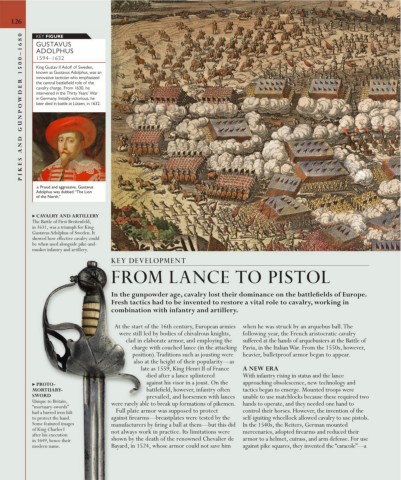
            ▶ CAVALRY AND ARTILLERY
            The Battle of First Breitenfeld,
            in 1631, was a triumph for King
            Gustavus Adolphus of Sweden. It
            showed how effective cavalry could
            be when used alongside pike-and-
            musket infantry and artillery.
                                         KEY DEVELOPMENT
                                         FROM LANCE TO PISTOL


                                         In the gunpowder age, cavalry lost their dominance on the battlefields of Europe.
                                         Fresh tactics had to be invented to restore a vital role to cavalry, working in
                                         combination with infantry and artillery.


                                          At the start of the 16th century, European armies  when he was struck by an arquebus ball. The
                                           were still led by bodies of chivalrous knights,    following year, the French aristocratic cavalry
                                              clad in elaborate armor, and employing the   suffered at the hands of arquebusiers at the Battle of
                                                charge with couched lance (in the attacking  Pavia, in the Italian War. From the 1550s, however,
                                                position). Traditions such as jousting were   heavier, bulletproof armor began to appear.
                                                 also at the height of their popularity—as
                                                   late as 1559, King Henri II of France   A NEW ERA
                                                     died after a lance splintered      With infantry rising in status and the lance
            ▶ PROTO-                                 against his visor in a joust. On the   approaching obsolescence, new technology and
            MORTUARY-                                battlefield, however, infantry often   tactics began to emerge. Mounted troops were
            SWORD                                    prevailed, and horsemen with lances  unable to use matchlocks because these required two
            Unique to Britain,           were rarely able to break up formations of pikemen.  hands to operate, and they needed one hand to
            “mortuary-swords”
            had a barred iron hilt        Full plate armor was supposed to protect      control their horses. However, the invention of the
            to protect the hand.         against firearms—breastplates were tested by the   self-igniting wheellock allowed cavalry to use pistols.
            Some featured images         manufacturers by firing a ball at them—but this did  In the 1540s, the Reiters, German mounted
            of King Charles I            not always work in practice. Its limitations were   mercenaries, adopted firearms and reduced their
            after his execution
            in 1649, hence their         shown by the death of the renowned Chevalier de   armor to a helmet, cuirass, and arm defense. For use
            modern name.                 Bayard, in 1524, whose armor could not save him   against pike squares, they invented the “caracole”—a

