


Page 130 - (DK) Smithsinian - Military History: The Definitive Visual Guide to the Objects of Warfare
P. 130
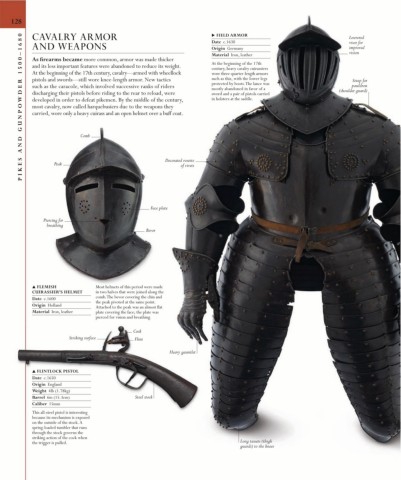
128    CAVALRY ARMOR                                                   ▶ FIELD ARMOR                                    Louvered

         WDER 1500–1680  AND WEAPONS                                        Origin  Germany                               (shoulder guard)
                                                                            Date  c.1630
                                                                                                                             visor for
                                                                                                                             improved
                                                                                                                             vision
                                                                            Material  Iron, leather
            As firearms became more common, armor was made thicker
                                                                            At the beginning of the 17th
            and its less important features were abandoned to reduce its weight.
                                                                            century, heavy cavalry cuirassiers
            At the beginning of the 17th century, cavalry—armed with wheellock
                                                                            wore three-quarter-length armors
                                                                            such as this, with the lower legs
            pistols and swords—still wore knee-length armor. New tactics
                                                                                                                               Strap for
                                                                            protected by boots. The lance was
            such as the caracole, which involved successive ranks of riders
                                                                                                                              pauldron
                                                                            mostly abandoned in favor of a
            discharging their pistols before riding to the rear to reload, were
                                                                            sword and a pair of pistols carried
                                                                            in holsters at the saddle.
         AND GUNPO  developed in order to defeat pikemen. By the middle of the century,
            most cavalry, now called harquebusiers due to the weapons they
            carried, wore only a heavy cuirass and an open helmet over a buff coat.
                              Comb
         PIKES      Peak                                    Decorated rosette
                                                                 of rivets


                                                       Face plate
                Piercing for
                  breathing
                                                     Bevor


            ▲ FLEMISH              Most helmets of this period were made
            CUIRASSIER’S HELMET    in two halves that were joined along the
            Date  c.1600           comb. The bevor covering the chin and
                                   the peak pivoted at the same point.
            Origin  Holland        Attached to the peak was an almost flat
            Material  Iron, leather  plate covering the face; the plate was
                                   pierced for vision and breathing.

                                                Cock
                         Striking surface        Flint

                                                             Heavy gauntlet


            ▲ FLINTLOCK PISTOL
            Date  c.1650
            Origin  England
            Weight  4lb (1.78kg)
            Barrel  6in (15.3cm)                 Steel stock
            Caliber  15mm
            This all-steel pistol is interesting
            because its mechanism is exposed
            on the outside of the stock. A
            spring-loaded tumbler that runs
            through the stock governs the
            striking action of the cock when
            the trigger is pulled.                                                     Long tassets (thigh
                                                                                       guards) to the knees

