


Page 132 - (DK) Smithsinian - Military History: The Definitive Visual Guide to the Objects of Warfare
P. 132
130    KEY DEVELOPMENT

         WDER 1500–1680  THE ISLAMIC


            EMPIRES AT WAR


            The Muslim empires of the Ottomans, Mughals, and Safavids ruled a large swathe
            of Eurasia in the 16th and 17th centuries.  Their armies combined Asian tribal

         AND GUNPO  heritage, reflected in the importance of horsemen, with gunpowder weapons.
            The Mughals originated from Central Asia. Led by
                                                           lances, javelins, and swords, they were supported
            Zahir-ud-Din Babur, they conquered Afghanistan
                                                           by lighter horsemen with composite bows,
                                                           known as akinji, who acted as scouts, raiders, and
            and northern India in the early 16th century,
            founding the Mughal Empire. Under Babur’s
                                                           skirmishers. The power of Ottoman cannon was
                                                           famous, and their artillery boasted almost 3,000
            successors, Mughal rule extended over the Indian
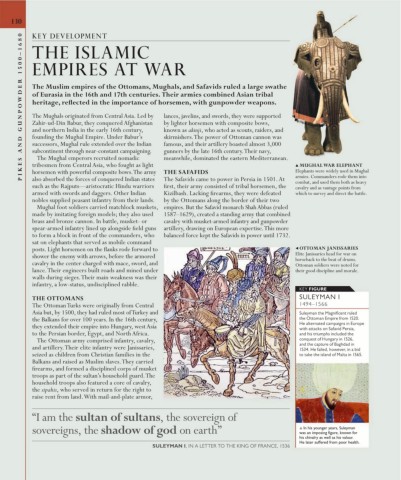
         PIKES   subcontinent through near-constant campaigning.   gunners by the late 16th century. Their navy,   ▲ MUGHAL WAR ELEPHANT
                                                           meanwhile, dominated the eastern Mediterranean.
              The Mughal emperors recruited nomadic
            tribesmen from Central Asia, who fought as light
                                                                                                          Elephants were widely used in Mughal
            horsemen with powerful composite bows. The army  THE SAFAFIDS
                                                                                                          armies. Commanders rode them into
            also absorbed the forces of conquered Indian states
            such as the Rajputs—aristocratic Hindu warriors   The Safavids came to power in Persia in 1501. At   combat, and used them both as heavy
                                                           first, their army consisted of tribal horsemen, the
                                                                                                          cavalry and as vantage points from
            armed with swords and daggers. Other Indian    Kizilbash. Lacking firearms, they were defeated    which to survey and direct the battle.
            nobles supplied peasant infantry from their lands.   by the Ottomans along the border of their two
              Mughal foot soldiers carried matchlock muskets,  empires. But the Safavid monarch Shah Abbas (ruled
            made by imitating foreign models; they also used   1587–1629), created a standing army that combined
            brass and bronze cannon. In battle, musket- or   cavalry with musket-armed infantry and gunpowder
            spear-armed infantry lined up alongside field guns  artillery, drawing on European expertise. This more
            to form a block in front of the commanders, who   balanced force kept the Safavids in power until 1732.
            sat on elephants that served as mobile command
            posts. Light horsemen on the flanks rode forward to                                           ◀ OTTOMAN JANISSARIES
            shower the enemy with arrows, before the armored                                              Elite Janissaries head for war on
            cavalry in the center charged with mace, sword, and                                           horseback to the beat of drums.
                                                                                                          Ottoman soldiers were noted for
            lance. Their engineers built roads and mined under                                            their good discipline and morale.
            walls during sieges. Their main weakness was their
            infantry, a low-status, undisciplined rabble.
                                                                                                            KEY FIGURE
            THE OTTOMANS                                                                                    SULEYMAN I
            The Ottoman Turks were originally from Central                                                  1494–1566
            Asia but, by 1500, they had ruled most of Turkey and                                            Suleyman the Magnificent ruled
            the Balkans for over 100 years. In the 16th century,                                            the Ottoman Empire from 1520.
            they extended their empire into Hungary, west Asia                                              He alternated campaigns in Europe
                                                                                                            with attacks on Safavid Persia,
            to the Persian border, Egypt, and North Africa.                                                 and his triumphs included the
              The Ottoman army comprised infantry, cavalry,                                                 conquest of Hungary in 1526,
            and artillery. Their elite infantry were Janissaries,                                           and the capture of Baghdad in
                                                                                                            1534. He failed, however, in a bid
            seized as children from Christian families in the                                               to take the island of Malta in 1565.
            Balkans and raised as Muslim slaves. They carried
            firearms, and formed a disciplined corps of musket
            troops as part of the sultan’s household guard. The
            household troops also featured a core of cavalry,
            the sipahis, who served in return for the right to
            raise rent from land. With mail-and-plate armor,


            “I am the sultan of sultans, the sovereign of
            sovereigns, the shadow of god on earth”                                                         ▲ In his younger years, Suleyman
                                                                                                            was an imposing figure, known for
                                                                                                            his chivalry as well as his valour.
                                                                                                            He later suffered from poor health.
                                                       SULEYMAN I, IN A LETTER TO THE KING OF FRANCE, 1536

