


Page 129 - (DK) Smithsinian - Military History: The Definitive Visual Guide to the Objects of Warfare
P. 129
127


                                                                                                            KEY EVENTS                  FR
                                                                                                            1500–1650

                                                                                                            ◼ 1515  King François I of France
                                                                                                            wins the Battle of Marignano,
                                                                                                            with a charge by fully armored
                                                                                                            horsemen with couched lance.  OM LANCE  T
                                                                                                            ◼ c.1540  German cavalry, the
                                                                                                            Reiters, adopt the wheel-lock
                                                                                                            pistol as their main armament.
                                                                                                            ◼ 1562  Cavalry use the
                                                                                                            “caracole” tactic at the Battle
                                                                                                            of Dreux, during the French    O PIST
                                                                                                            Wars of Religion.
                                                                                                            ◼ 1590  At the Battle of Ivry,   OL
                                                                                                            Henry of Navarre triumphs
                                                                                                            using a cavalry charge with
                                                                                                            pistol and sword.

                                                                                                            ◼ c.1600  European armies
                                                                                                            introduce dragoons—horsemen
                                                                                                            who fought dismounted with
                                                                                                            carbines (shorter muskets).

                                                                                                            ◼ 1610  Polish hussars defeat
                                                                                                            the Russians and Swedes at the
                                                                                                            battle of Klushino.
                                                                                                            ◼ 1630  In the Thirty Years’
                                                                                                            War, the Swedish combine
                                                                                                            cavalry with other arms.
                                                                                                            ◼ 1640s  In the English Civil
                                                                                                            Wars, Oliver Cromwell’s
                                                                                                            Ironside cavalry fights in a
                                                                                                            disciplined close formation.


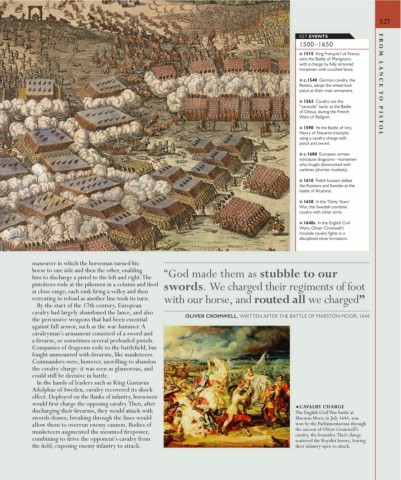
            maneuver in which the horseman turned his
            horse to one side and then the other, enabling    “God made them as stubble to our
            him to discharge a pistol to the left and right. The
            pistoleers rode at the pikemen in a column and fired   swords. We charged their regiments of foot
            at close range, each rank firing a volley and then
            retreating to reload as another line took its turn.   with our horse, and routed all we charged”
              By the start of the 17th century, European
            cavalry had largely abandoned the lance, and also
            the percussive weapons that had been essential         OLIVER CROMWELL, WRITTEN AFTER THE BATTLE OF MARSTON MOOR, 1644
            against full armor, such as the war-hammer. A
            cavalryman’s armament consisted of a sword and
            a firearm, or sometimes several preloaded pistols.
            Companies of dragoons rode to the battlefield, but
            fought unmounted with firearms, like musketeers.
            Commanders were, however, unwilling to abandon
            the cavalry charge: it was seen as glamorous, and
            could still be decisive in battle.
              In the hands of leaders such as King Gustavus
            Adolphus of Sweden, cavalry recovered its shock
            effect. Deployed on the flanks of infantry, horsemen
            would first charge the opposing cavalry. Then, after                                          ◀ CAVALRY CHARGE
            discharging their firearms, they would attack with                                            The English Civil War battle at
            swords drawn; breaking through the lines would                                                Marston Moor, in July 1644, was
            allow them to overrun enemy cannon. Bodies of                                                 won by the Parliamentarians through
            musketeers augmented the mounted firepower,                                                   the success of Oliver Cromwell’s
                                                                                                          cavalry, the Ironsides. Their charge
            combining to drive the opponent’s cavalry from                                                scattered the Royalist horses, leaving
            the field, exposing enemy infantry to attack.                                                 their infantry open to attack.

