


Page 134 - (DK) Smithsinian - Military History: The Definitive Visual Guide to the Objects of Warfare
P. 134
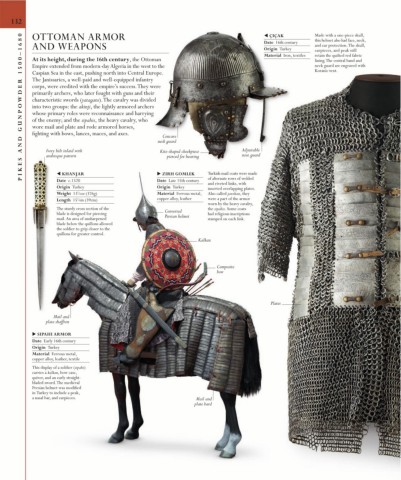
132    OTTOMAN ARMOR                                                                      ◀ ÇIÇAK           Made with a one-piece skull,

         WDER 1500–1680  AND WEAPONS                                                           Origin  Turkey    and ear protection. The skull,
                                                                                                                 this helmet also had face, neck,
                                                                                               Date  16th century
                                                                                                                 earpieces, and peak still
                                                                                               Material  Iron, textiles
                                                                                                                 retain the quilted red fabric
            At its height, during the 16th century, the Ottoman
                                                                                                                 lining. The central band and
                                                                                                                 neck guard are engraved with
            Empire extended from modern-day Algeria in the west to the
                                                                                                                 Koranic text.
            Caspian Sea in the east, pushing north into Central Europe.
            The Janissaries, a well-paid and well-equipped infantry
            corps, were credited with the empire’s success. They were
            primarily archers, who later fought with guns and their
         AND GUNPO  characteristic swords (yatagans). The cavalry was divided  neck guard
            into two groups: the akinji, the lightly armored archers
            whose primary roles were reconnaissance and harrying
            of the enemy; and the sipahis, the heavy cavalry, who
            wore mail and plate and rode armored horses,
            fighting with bows, lances, maces, and axes.
                                                           Concave

                                                                                       Adjustable
                                                          Kite-shaped cheekpiece
                                                                                       nose guard
                 arabesque pattern
                                                            pierced for hearing
         PIKES   Ivory hilt inlaid with                  ▶ ZIRH GOMLEK     Turkish mail coats were made
                     ◀ KHANJAR
                                                                           of alternate rows of welded
                                                         Date  Late 15th century
                     Date  c.1520
                                                                           and riveted links, with
                     Origin  Turkey                      Origin  Turkey    inserted overlapping plates.
                     Weight  13 ⁄4oz (376g)              Material  Ferrous metal,   Also called jawshan, they
                            1
                     Length  15 ⁄4in (39cm)              copper alloy, leather  were a part of the armor
                            1
                                                                           worn by the heavy cavalry,
                     The sturdy cross section of the                       the sipahis. Some coats
                     blade is designed for piercing         Converted      had religious inscriptions
                     mail. An area of unsharpened           Persian helmet  stamped on each link.
                     blade below the quillons allowed
                     the soldier to grip closer to the
                     quillons for greater control.
                                                                        Kalkan

                                                                              Composite
                                                                              bow


                                                                                                  Plates

                    Mail and
                 plate shaffron

            ▶ SIPAHI ARMOR
            Date  Early 16th century
            Origin  Turkey
            Material  Ferrous metal,
            copper alloy, leather, textile
            This display of a soldier (sipahi)
            carries a kalkan, bow case,
            quiver, and an early straight-
            bladed sword. The medieval
            Persian helmet was modified
            in  Turkey to include a peak,
            a nasal bar, and earpieces.                                Mail and
                                                                      plate bard

