


Page 141 - (DK) Smithsinian - Military History: The Definitive Visual Guide to the Objects of Warfare
P. 141
139


            of the Great Wall, created a military organization
            known as the Eight Banners. In 1644, the decline
            of the Chinese Ming dynasty led to political chaos
            that the Manchu exploited, seizing Beijing and
            establishing the Qing dynasty. It took 40 years of
            warfare, however, to extend Manchu rule over the                                                                            CONFLICT IN EAST
            whole of China. Originally steppe cavalry fighting
            with bows, swords, and spears, the Manchu had
            to adapt to the use of mass peasant armies, naval
            warfare on river and sea, and an array of Chinese
            gunpowder weaponry. However, the capture of
            Taiwan in 1683 by means of a seaborne invasion
            marked the final triumph of Emperor Kangxi of
            the Manchu over the Ming loyalists.                                                                                         ASIA
              In southeast Asia, meanwhile, the warring
            kingdoms of Burma and Siam were maintaining
            a very different tradition of warfare, in which
            armies were based around units of massed war
            elephants used as a shock force.


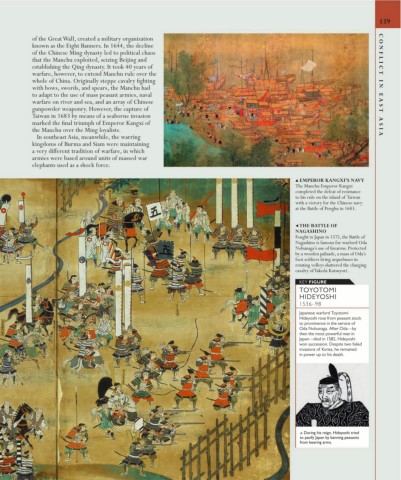
                                                                                                          ▲ EMPEROR KANGXI’S NAVY
                                                                                                          The Manchu Emperor Kangxi
                                                                                                          completed the defeat of resistance
                                                                                                          to his rule on the island of  Taiwan
                                                                                                          with a victory for the Chinese navy
                                                                                                          at the Battle of Penghu in 1683.


                                                                                                          ◀ THE BATTLE OF
                                                                                                          NAGASHINO
                                                                                                          Fought in Japan in 1575, the Battle of
                                                                                                          Nagashino is famous for warlord Oda
                                                                                                          Nobunaga’s use of firearms. Protected
                                                                                                          by a wooden palisade, a mass of Oda’s
                                                                                                          foot soldiers firing arquebuses in
                                                                                                          rotating volleys shattered the charging
                                                                                                          cavalry of Takeda Katsuyori.

                                                                                                            KEY FIGURE
                                                                                                            TOYOTOMI
                                                                                                            HIDEYOSHI
                                                                                                            1536–98
                                                                                                            Japanese warlord Toyotomi
                                                                                                            Hideyoshi rose from peasant stock
                                                                                                            to prominence in the service of
                                                                                                            Oda Nobunaga. After Oda—by
                                                                                                            then the most powerful man in
                                                                                                            Japan—died in 1582, Hideyoshi
                                                                                                            won succession. Despite two failed
                                                                                                            invasions of Korea, he remained
                                                                                                            in power up to his death.


                                                                                                            ▲ During his reign, Hideyoshi tried
                                                                                                            to pacify Japan by banning peasants
                                                                                                            from bearing arms.

