


Page 142 - (DK) Smithsinian - Military History: The Definitive Visual Guide to the Objects of Warfare
P. 142
140    EAST ASIAN SWORDS

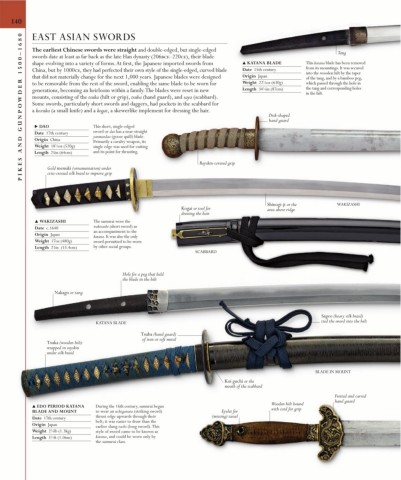
         WDER 1500–1680  The earliest Chinese swords were straight and double-edged, but single-edged   ▲ KATANA BLADE   This katana blade has been removed


                                                                                                                         Tang
            swords date at least as far back as the late Han dynasty (206bce–220ce), their blade
            shape evolving into a variety of forms. At first, the Japanese imported swords from
                                                                                                              from its mountings. It was secured
            China, but by 1000ce, they had perfected their own style of the single-edged, curved blade
                                                                                       Date  15th century
                                                                                                              into the wooden hilt by the taper
                                                                                       Origin  Japan
            that did not materially change for the next 1,000 years. Japanese blades were designed
                                                                                                              of the tang, and by a bamboo peg,
                                                                                       Weight  22 ⁄4oz (630g)
                                                                                               1
                                                                                                              which passed through the hole in
            to be removable from the rest of the sword, enabling the same blade to be worn for
                                                                                                              the tang and corresponding holes
                                                                                               1
                                                                                       Length  34 ⁄4in (87cm)
            generations, becoming an heirloom within a family. The blades were reset in new
                                                                                                              in the hilt.
            mounts, consisting of the tsuka (hilt or grip), tsuba (hand guard), and saya (scabbard).
         AND GUNPO  Some swords, particularly short swords and daggers, had pockets in the scabbard for    Disk-shaped
            a kozuka (a small knife) and a kogai, a skewerlike implement for dressing the hair.
                                                                                                 hand guard
                                  This short, single-edged
             ▶ DAO
                                  sword or dao has a near-straight
             Date  17th century
                                  yanmaodao (goose quill) blade.
             Origin  China
                                  Primarily a cavalry weapon, its
             Weight  18 ⁄4oz (520g)
                     1
                                  single edge was used for cutting
         PIKES   Length  25in (64cm)  and its point for thrusting.      Rayskin-covered grip
                  Gold menuki (ornamentation) under
                  criss-crossed silk braid to improve grip
                                                                                                Shinogi-ji or the        WAKIZASHI
                                                                  Kogai or tool for             area above ridge
                                                                  dressing the hair
             ▲ WAKIZASHI          The samurai wore the
             Date  c.1640         wakizashi (short sword) as
                                  an accompaniment to the
             Origin  Japan
                                  katana. It was also the only
             Weight  17oz (480g)  sword permitted to be worn
             Length  21in  (53.4cm)  by other social groups.
                                                                       SCABBARD

                                             Hole for a peg that held
                                             the blade in the hilt

                    Nakago or tang


                                                                                                                    Sageo (heavy silk braid)
                                   KATANA BLADE                                                                     tied the sword into the belt

                                                   Tsuba (hand guard)
                                                    of iron or soft metal
                  Tsuka (wooden hilt)
                  wrapped in rayskin
                  under silk braid


                                                                                                                 BLADE IN MOUNT
                                                                                 Koi guchi or the
                                                                                 mouth of the scabbard
                                                                                                                        Fretted and carved
                                                                                                                        hand guard
                                                                                                  Wooden hilt bound
            ▲ EDO PERIOD KATANA    During the 16th century, samurai began
            BLADE AND MOUNT        to wear an uchiganata (striking sword)       Eyelet for        with cord for grip
            Date  17th century     thrust edge upwards through their         (missing) tassel
                                   belt; it was easier to draw than the
            Origin  Japan          earlier slung tachi (long sword). This
                   3
            Weight  2 ⁄4lb (1.3kg)  style of sword came to be known as
                   1
            Length  3 ⁄2ft (1.06m)  katana, and could be worn only by
                                   the samurai class.

