


Page 199 - (DK) Smithsinian - Military History: The Definitive Visual Guide to the Objects of Warfare
P. 199
197


                                                                                                                                        NA V AL BA


                                                                                                          ▲ A GUN CREW AT               TTLES IN  THE
                                                                                                          BATTLE STATIONS
                                                                                                          To fire a naval cannon, the crew   A
                                                                                                          rammed a gunpowder cartridge and
                                                                                                          cannonball down the barrel, “ran” the
                                                                                                          gun out so the barrel protruded from
                                                                                                          the gun port, and ignited the charge.  GE OF SAIL


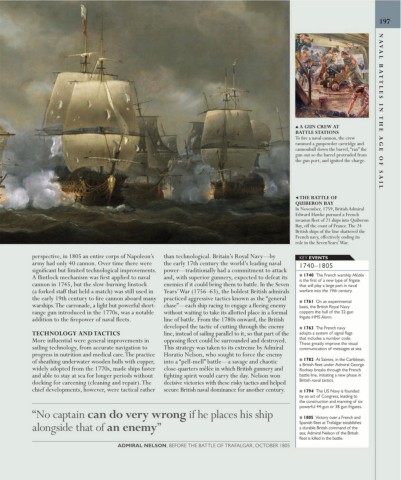
                                                                                                          ◀ THE BATTLE OF
                                                                                                          QUIBERON BAY
                                                                                                          In November, 1759, British Admiral
                                                                                                          Edward Hawke pursued a French
                                                                                                          invasion fleet of 21 ships into Quiberon
                                                                                                          Bay, off the coast of France. The 24
                                                                                                          British ships of the line shattered the
                                                                                                          French navy, effectively ending its
                                                                                                          role in the Seven Years’ War.

            perspective, in 1805 an entire corps of Napoleon’s   than technological. Britain’s Royal Navy—by
                                                                                                            KEY EVENTS
            army had only 40 cannon. Over time there were   the early 17th century the world’s leading naval   1740–1805
            significant but limited technological improvements.  power—traditionally had a commitment to attack
            A flintlock mechanism was first applied to naval   and, with superior gunnery, expected to defeat its   ◼ 1740  The French warship Médée
            cannon in 1745, but the slow-burning linstock    enemies if it could bring them to battle. In the Seven   is the first of a new type of frigate
                                                                                                            that will play a large part in naval
            (a forked staff that held a match) was still used in   Years’ War (1756–63), the boldest British admirals   warfare into the 19th century.
            the early 19th century to fire cannon aboard many  practiced aggressive tactics known as the “general
            warships. The carronade, a light but powerful short-  chase”—each ship racing to engage a fleeing enemy   ◼ 1761  On an experimental
                                                                                                            basis, the British Royal Navy
            range gun introduced in the 1770s, was a notable   without waiting to take its allotted place in a formal   coppers the hull of the 32-gun
            addition to the firepower of naval fleets.     line of battle. From the 1780s onward, the British   frigate HMS Alarm.
                                                           developed the tactic of cutting through the enemy   ◼ 1763  The French navy
            TECHNOLOGY AND TACTICS                         line, instead of sailing parallel to it, so that part of the   adopts a system of signal flags
            More influential were general improvements in   opposing fleet could be surrounded and destroyed.   that includes a number code.
                                                                                                            These greatly improve the visual
            sailing technology, from accurate navigation to   This strategy was taken to its extreme by Admiral   communication of messages at sea.
            progress in nutrition and medical care. The practice   Horatio Nelson, who sought to force the enemy
            of sheathing underwater wooden hulls with copper,   into a “pell-mell” battle—a savage and chaotic   ◼ 1782  At Saintes, in the Caribbean,
                                                                                                            a British fleet under Admiral George
            widely adopted from the 1770s, made ships faster   close-quarters mêlée in which British gunnery and   Rodney breaks through the French
            and able to stay at sea for longer periods without   fighting spirit would carry the day. Nelson won   battle line, initiating a new phase in
            docking for careening (cleaning and repair). The   decisive victories with these risky tactics and helped   British naval tactics.
            chief developments, however, were tactical rather   secure British naval dominance for another century.  ◼ 1794  The US Navy is founded
                                                                                                            by an act of Congress, leading to
                                                                                                            the construction and manning of six
                                                                                                            powerful 44-gun or 38-gun frigates.
            “No captain can do very wrong if he places his ship                                             ◼ 1805  Victory over a French and

            alongside that of an enemy”                                                                     Spanish fleet at Trafalgar establishes
                                                                                                            a durable British command of the
                                                                                                            sea; Admiral Nelson of the British
                                                                                                            fleet is killed in the battle.
                                           ADMIRAL NELSON, BEFORE THE BATTLE OF TRAFALGAR, OCTOBER 1805

