Page 281 - (DK) Smithsinian - Military History: The Definitive Visual Guide to the Objects of Warfare
P. 281
279

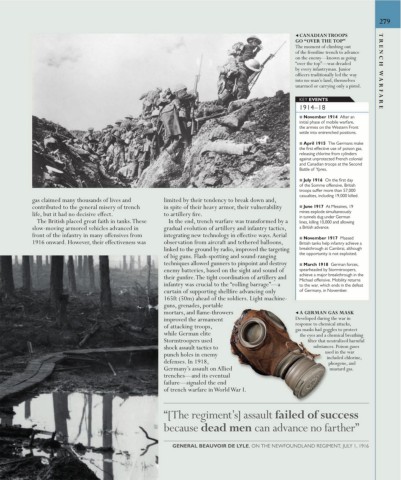
                                                                                                          ◀ CANADIAN TROOPS
                                                                                                          GO “OVER  THE  TOP”
                                                                                                          The moment of climbing out
                                                                                                          of the frontline trench to advance    TRENCH W
                                                                                                          on the enemy—known as going
                                                                                                          “over the top”—was dreaded
                                                                                                          by every infantryman. Junior
                                                                                                          officers traditionally led the way
                                                                                                          into no-man’s-land, themselves
                                                                                                          unarmed or carrying only a pistol.  ARF


                                                                                                            KEY EVENTS                  ARE
                                                                                                            1914–18

                                                                                                            ◼ November 1914  After an
                                                                                                            initial phase of mobile warfare,
                                                                                                            the armies on the Western Front
                                                                                                            settle into entrenched positions.
                                                                                                            ◼ April 1915  The Germans make
                                                                                                            the first effective use of poison gas,
                                                                                                            releasing chlorine from cylinders
                                                                                                            against unprotected French colonial
                                                                                                            and Canadian troops at the Second
                                                                                                            Battle of Ypres.

                                                                                                            ◼ July 1916  On the first day
                                                                                                            of the Somme offensive, British
                                                                                                            troops suffer more than 57,000
                                                                                                            casualties, including 19,000 killed.
            gas claimed many thousands of lives and        limited by their tendency to break down and,
            contributed to the general misery of trench    in spite of their heavy armor, their vulnerability    ◼ June 1917  At Messines, 19
            life, but it had no decisive effect.           to artillery fire.                               mines explode simultaneously
                                                                                                            in tunnels dug under German
              The British placed great faith in tanks. These   In the end, trench warfare was transformed by a   lines, killing 10,000 and allowing
            slow-moving armored vehicles advanced in       gradual evolution of artillery and infantry tactics,   a British advance.
            front of the infantry in many offensives from    integrating new technology in effective ways. Aerial
            1916 onward. However, their effectiveness was   observation from aircraft and tethered balloons,   ◼ November 1917  Massed
                                                                                                            British tanks help infantry achieve a
                                                           linked to the ground by radio, improved the targeting   breakthrough at Cambrai, although
                                                           of big guns. Flash-spotting and sound-ranging    the opportunity is not exploited.
                                                           techniques allowed gunners to pinpoint and destroy   ◼ March 1918  German forces,
                                                           enemy batteries, based on the sight and sound of   spearheaded by Stormtroopers,
                                                           their gunfire. The tight coordination of artillery and   achieve a major breakthrough in the
                                                                                                            Michael offensive. Mobility returns
                                                           infantry was crucial to the “rolling barrage”—a   to the war, which ends in the defeat
                                                           curtain of supporting shellfire advancing only   of Germany, in November.
                                                           165ft (50m) ahead of the soldiers. Light machine-
                                                           guns, grenades, portable
                                                           mortars, and flame-throwers                    ◀ A GERMAN GAS MASK
                                                           improved the armament                          Developed during the war in
                                                           of attacking troops,                           response to chemical attacks,
                                                           while German elite                             gas masks had goggles to protect
                                                                                                            the eyes and a chemical breathing
                                                           Stormtroopers used                                  filter that neutralized harmful
                                                           shock assault tactics to                              substances. Poison gases
                                                           punch holes in enemy                                      used in the war
                                                           defenses. In 1918,                                         included chlorine,
                                                                                                                      phosgene, and
                                                           Germany’s assault on Allied                                 mustard gas.
                                                           trenches—and its eventual
                                                           failure—signaled the end
                                                           of trench warfare in World War I.


                                                           “[The regiment’s] assault failed of success

                                                           because dead men can advance no farther”


                                                              GENERAL BEAUVOIR DE LYLE, ON THE NEWFOUNDLAND REGIMENT, JULY 1, 1916
   276   277   278   279   280   281   282   283   284   285   286