


Page 280 - (DK) Smithsinian - Military History: The Definitive Visual Guide to the Objects of Warfare
P. 280
278                                 KEY DEVELOPMENT

         1914–1945  KEY BATTLE           TRENCH WARFARE
              BATTLE OF VERDUN
              1916
              In February 1916, the Germans
              attacked the French trenches at
                                         World War I (1914–18) was industrialized conflict on a massive scale, with
              in their preliminary bombardment.
         ARS   Verdun, firing over a million shells    factories supplying weapons and munitions for armies totaling millions.
              A battle of attrition followed, in
                                         Trench warfare, born out of this new, large-scale firepower, favored the
              which more than 500,000 men
              died, with little gain to either side.
                                         defenders, especially if they were protected behind barbed wire.
         ORLD W                          By 1915, a double line of trenches stretched    guns and rapid-fire rifles. Even when enemy
                                                                                        front-line trenches were captured, assaults
                                         across France and Belgium, with troops facing one
                                         another across no-man’s-land. This new kind of field  floundered as the attackers pushed farther
         THE W                           fortification was a response to increasing artillery   forward over ground that had been churned
                                         and infantry firepower, as was the adoption of steel
                                                                                        up by shells. The advancing troops could no
                                                                                        longer communicate with their own lines by
                                         helmets by all armies.  Trenches developed into
                                         elaborate defense systems: the Germans in particular  field telephone, with the result that the defenders
                                         constructed complexes of concrete bunkers and   were often able to move reserves to a danger
                                         concealed machine-gun nests that extended for   spot quicker than the attackers could reinforce
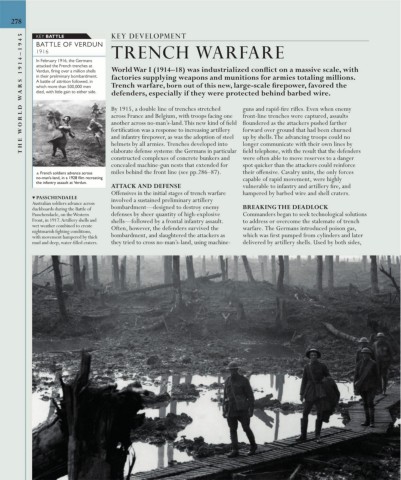
              ▲ French soldiers advance across   miles behind the front line (see pp.286–87).  their offensive. Cavalry units, the only forces
              no-man’s-land, in a 1928 film recreating                                  capable of rapid movement, were highly
              the infantry assault at Verdun.
                                         ATTACK AND DEFENSE                             vulnerable to infantry and artillery fire, and
                                         Offensives in the initial stages of trench warfare   hampered by barbed wire and shell craters.
            ▼ PASSCHENDAELE              involved a sustained preliminary artillery
            Australian soldiers advance across
            duckboards during the Battle of   bombardment—designed to destroy enemy     BREAKING THE DEADLOCK
            Passchendaele, on the Western    defenses by sheer quantity of high-explosive    Commanders began to seek technological solutions
            Front, in 1917. Artillery shells and    shells—followed by a frontal infantry assault.   to address or overcome the stalemate of trench
            wet weather combined to create   Often, however, the defenders survived the   warfare.  The Germans introduced poison gas,
            nightmarish fighting conditions,
            with movement hampered by thick   bombardment, and slaughtered the attackers as    which was first pumped from cylinders and later
            mud and deep, water-filled craters.  they tried to cross no-man’s-land, using machine-  delivered by artillery shells. Used by both sides,

