


Page 302 - (DK) Smithsinian - Military History: The Definitive Visual Guide to the Objects of Warfare
P. 302
300                                 KEY DEVELOPMENT

         1914–1945  KEY EVENTS           THE GROWTH OF
              1914–45

              ◼ 1915  The invention of the
              interrupter gear allows a pilot to fire
                                         AIR POWER
              a machine-gun through his propeller
              arc, leading to the development of
         ARS   the first fighter planes.  The most influential innovation in warfare between 1914 and 1945 was the
              ◼ 1935  The UK begins work on
              an air defense system, based on a
                                         development of air power. Combat aircraft became not only a vital adjunct
              chain of coastal radar stations, to
         ORLD W  give early warning of aerial threats.  to army and navy operations, but also an instrument for direct attack upon
                                         the enemy’s homeland and infrastructure.
              ◼ 1937  German aircraft
              intervening in the Spanish Civil
              War destroy the Basque town
                                                                                        were engaged in aerial combat over the Western
                                         Although there had been a few minor uses of
         THE W  of Guernica by aerial bombing.  aircraft in war before 1914, it was World War I    front. Air aces, the most successful fighter pilots,
                                                                                        were celebrated as “knights of the air.”
                                         that saw the first true age of military aviation. The
              ◼ 1938  The Boeing B-17 Flying
              Fortress (see pp.314–17) heavy
                                         main combatants entered the war with about 500
              bomber is introduced. This all-metal
              monoplane can carry a 6,000lb
                                         the UK alone had 22,000 aircraft in service.
                                                                                        Military chiefs soon realized that aircraft could also
              (2,700kg) bomb load.       flimsy flying machines between them. By 1918,   STRATEGIC BOMBING
                                          The prime functions of aircraft were that of   be used for strategic bombing—direct air attacks
              ◼ 1944  The German
              Messerschmitt Me 262 Schwalbe   reconnaissance and artillery spotting—giving   on enemy cities. Germany led the world in lighter-
              (“Swallow”) is the first jet-engined   army gunners feedback on where their shells had   than-air flight, and their massive Zeppelin and
              fighter to enter service.
                                         landed. Experimental raids were also mounted    Schütte-Lanz rigid airships launched night raids
              ◼ 1945  American B-29 bombers   on targets behind enemy lines, with small bombs   on London and other cities from 1915. Airships
              drop atomic bombs on the Japanese   dropped by hand. Fighter aircraft were later sent    proved too slow-moving and vulnerable once the
              cities of Hiroshima (see pp.378–79)
              and Nagasaki; Japan then surrenders.  up to shoot down bombers and reconnaissance   UK deployed night fighters in defense, and were
                                         planes, and, by 1916, fighters from opposing sides   replaced by heavier-than-air bomber aircraft. From
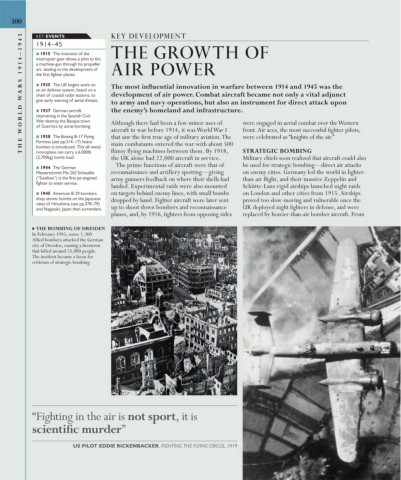
            ▶ THE BOMBING OF DRESDEN
            In February 1945, some 1,300
            Allied bombers attacked the German
            city of Dresden, causing a firestorm
            that killed around 25,000 people.
            The incident became a focus for
            criticism of strategic bombing.


            “Fighting in the air is not sport, it is

            scientific murder”


                           US PILOT EDDIE RICKENBACKER, FIGHTING THE FLYING CIRCUS, 1919

