


Page 300 - (DK) Smithsinian - Military History: The Definitive Visual Guide to the Objects of Warfare
P. 300
298    COMMUNICATIONS EQUIPMENT

         1914–1945  OF WORLD WAR I                                                                                Origin  UK

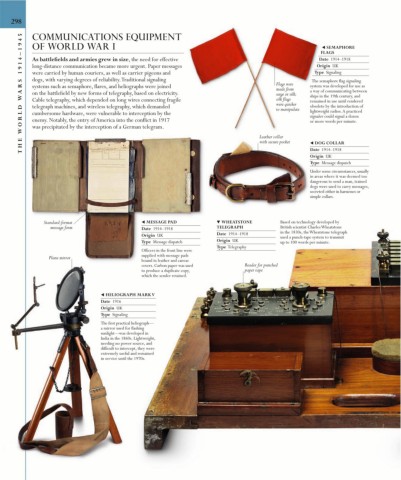
                                                                                                                    ◀ SEMAPHORE
                                                                                                                   FLAGS
            As battlefields and armies grew in size, the need for effective
                                                                                                                   Date  1914–1918
            long-distance communication became more urgent. Paper messages
                                                                                                                 Type  Signaling
         ARS   were carried by human couriers, as well as carrier pigeons and                      Flags were   system was developed for use as
            dogs, with varying degrees of reliability. Traditional signaling
                                                                                                                The semaphore flag signaling
            systems such as semaphore, flares, and heliographs were joined
                                                                                                   made from
                                                                                                                a way of communicating between
            on the battlefield by new forms of telegraphy, based on electricity.
                                                                                                   serge or silk;
                                                                                                                ships in the 19th century, and
         ORLD W  Cable telegraphy, which depended on long wires connecting fragile                 silk flags    remained in use until rendered
                                                                                                   were quicker
            telegraph machines, and wireless telegraphy, which demanded
                                                                                                                obsolete by the introduction of
                                                                                                   to manipulate
                                                                                                                lightweight radios. A practiced
            cumbersome hardware, were vulnerable to interception by the
                                                                                                                signaler could signal a dozen
            enemy. Notably, the entry of America into the conflict in 1917
                                                                                                                or more words per minute.
         THE W  was precipitated by the interception of a German telegram.                   Leather collar     ◀ DOG COLLAR
                                                                                             with secure pocket
                                                                                                                Date  1914–1918
                                                                                                                Origin  UK
                                                                                                                Type  Message dispatch
                                                                                                                Under some circumstances, usually
                                                                                                                in areas where it was deemed too
                                                                                                                dangerous to send a man, trained
                                                                                                                dogs were used to carry messages,
                                                                                                                secreted either in harnesses or
                                                                                                                simple collars.

                Standard-format                    ◀ MESSAGE PAD              ▼ WHEATSTONE           Based on technology developed by
                   message form                    Date  1914–1918            TELEGRAPH              British scientist Charles Wheatstone
                                                   Origin  UK                 Date  1914–1918        in the 1830s, the Wheatstone telegraph
                                                                                                     used a punch-tape system to transmit
                                                   Type  Message dispatch     Origin  UK             up to 100 words per minute.
                                                                              Type  Telegraphy
                                                   Officers in the front line were
                                                   supplied with message pads
                  Plane mirror
                                                   bound in leather and canvas
                                                   covers. Carbon paper was used        Reader for punched
                                                   to produce a duplicate copy,         paper tape
                                                   which the sender retained.

                                     ◀ HELIOGRAPH MARK V
                                     Date  1916
                                     Origin  UK
                                     Type  Signaling
                                     The first practical heliograph—
                                     a mirror used for flashing
                                     sunlight—was developed in
                                     India in the 1860s. Lightweight,
                                     needing no power source, and
                                     difficult to intercept, they were
                                     extremely useful and remained
                                     in service until the 1970s.

