


Page 303 - (DK) Smithsinian - Military History: The Definitive Visual Guide to the Objects of Warfare
P. 303
301


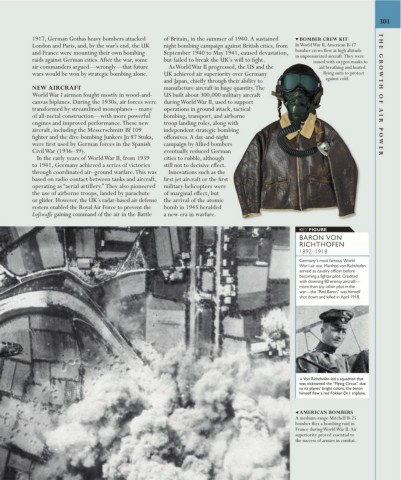
            1917, German Gothas heavy bombers attacked     of Britain, in the summer of 1940. A sustained   ▼ BOMBER CREW KIT
            London and Paris, and, by the war’s end, the UK    night bombing campaign against British cities, from   In World War II, American B-17
            and France were mounting their own bombing     September 1940 to May 1941, caused devastation,   bomber crews flew at high altitude    THE GR
            raids against German cities. After the war, some    but failed to break the UK’s will to fight.   in unpressurized aircraft. They were
                                                                                                                 issued with oxygen masks to
            air commanders argued—wrongly—that future        As World War II progressed, the US and the            aid breathing and heated   O
            wars would be won by strategic bombing alone.   UK achieved air superiority over Germany                flying suits to protect
                                                           and Japan, chiefly through their ability to               against cold.
            NEW AIRCRAFT                                   manufacture aircraft in huge quantity. The                                   WTH OF
            World War I airmen fought mostly in wood-and-  US built about 300,000 military aircraft
            canvas biplanes. During the 1930s, air forces were  during World War II, used to support
            transformed by streamlined monoplanes—many     operations in ground attack, tactical
            of all-metal construction—with more powerful   bombing, transport, and airborne
            engines and improved performance. These new    troop landing roles, along with                                              AIR PO
            aircraft, including the Messerschmitt Bf 109   independent strategic bombing
            fighter and the dive-bombing Junkers Ju 87 Stuka,   offensives. A day-and-night
            were first used by German forces in the Spanish   campaign by Allied bombers
            Civil War (1936–39).                           eventually reduced German                                                    WER
              In the early years of  World War II, from 1939    cities to rubble, although
            to 1941, Germany achieved a series of victories   still not to decisive effect.
            through coordinated air–ground warfare. This was   Innovations such as the
            based on radio contact between tanks and aircraft,  first jet aircraft or the first
            operating as “aerial artillery.”  They also pioneered   military helicopters were
            the use of airborne troops, landed by parachute    of marginal effect, but
            or glider. However, the UK’s radar-based air defense  the arrival of the atomic
            system enabled the Royal Air Force to prevent the   bomb in 1945 heralded
            Luftwaffe gaining command of the air in the Battle   a new era in warfare.


                                                                                                            KEY FIGURE
                                                                                                            BARON VON
                                                                                                            RICHTHOFEN
                                                                                                            1892–1918

                                                                                                            Germany’s most famous World
                                                                                                            War I air ace, Manfred von Richthofen
                                                                                                            served as cavalry officer before
                                                                                                            becoming a fighter pilot. Credited
                                                                                                            with downing 80 enemy aircraft—
                                                                                                            more than any other pilot in the
                                                                                                            war—the “Red Baron” was himself
                                                                                                            shot down and killed in April 1918.


                                                                                                            ▲ Von Richthofen led a squadron that
                                                                                                            was nicknamed the “Flying Circus” due
                                                                                                            to its planes’ bright colors; the baron
                                                                                                            himself flew a red Fokker Dr.1 triplane.


                                                                                                          ◀ AMERICAN BOMBERS
                                                                                                          A medium-range Mitchell B-25
                                                                                                          bomber flies a bombing raid in
                                                                                                          France during World War II. Air
                                                                                                          superiority proved essential to
                                                                                                          the success of armies in combat.

