


Page 305 - (DK) Smithsinian - Military History: The Definitive Visual Guide to the Objects of Warfare
P. 305
303


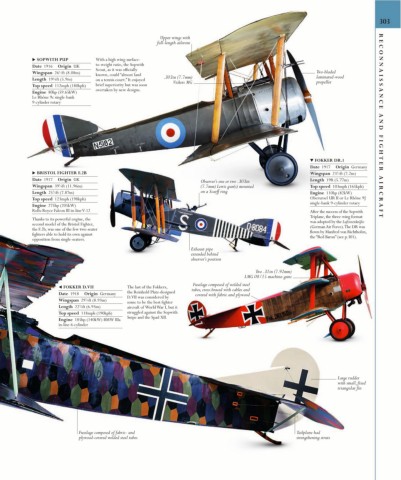
                                                          Upper wings with
                                                         full-length ailerons


            ▶ SOPWITH PUP          With a high wing-surface-
            Date  1916     Origin  UK  to-weight ratio, the Sopwith
                                   Scout, as it was officially
                      1
            Wingspan  26 ⁄2ft (8.08m)  known, could “almost land                                                  Two-bladed
            Length  19¼ft (5.9m)   on a tennis court.” It enjoyed   .303in (7.7mm)                                laminated-wood
                                                                                                                  propeller
                                                               Vickers MG
            Top speed  112mph (180kph)  brief superiority but was soon                                                                  RECONNAISSANCE AND
                                   overtaken by new designs.
            Engine  80hp (59.65kW)
            Le Rhône 9c single-bank
            9-cylinder rotary


                                                                                                                ▼ FOKKER DR.1
                                                                                                                Date  1917     Origin  Germany
            ▶ BRISTOL FIGHTER F.2B                                                                              Wingspan  23 ⁄2ft (7.2m)  FIGHTER AIRCRAFT
                                                                                                                         1
            Date  1917     Origin  UK                                                                           Length  19ft (5.77m)
                                                                        Observer’s one or two .303in
                      1
            Wingspan  39 ⁄4ft (11.96m)                                  (7.7mm) Lewis gun(s) mounted            Top speed  103mph (165kph)
                    3
            Length  25 ⁄4ft (7.87m)                                     on a Scarff ring                        Engine  110hp (82kW)
            Top speed  123mph (198kph)                                                                          Oberursel UR II or Le Rhône 9J
                                                                                                                single-bank 9-cylinder rotary
            Engine  275hp (205kW)
            Rolls-Royce Falcon III in-line V-12                                                                 After the success of the Sopwith
                                                                                                                Triplane, the three-wing format
            Thanks to its powerful engine, the                                                                  was adopted by the Luftstreitkräfte
            second model of the Bristol Fighter,                                                                (German Air Force). The DR was
            the F.2b, was one of the few two-seater                                                             flown by Manfred von Richthofen,
            fighters able to hold its own against                                                               the “Red Baron” (see p.301).
            opposition from single-seaters.
                                                                     Exhaust pipe
                                                                     extended behind
                                                                     observer’s position
                                                                                            Two .31in (7.92mm)
                                                                                        LMG 08/15 machine-guns
                                                                      Fuselage composed of welded steel
                      ◀ FOKKER D.VII          The last of the Fokkers,    tubes, cross-braced with cables and
                      Date  1918     Origin  Germany  the Reinhold Platz-designed    covered with fabric and plywood
                                              D.VII was considered by
                      Wingspan  29 ⁄4ft (8.93m)
                               1
                                              some to be the best fighter
                      Length  22 ⁄4ft (6.93m)  aircraft of  World War I, but it
                             3
                      Top speed  118mph (190kph)  struggled against the Sopwith
                      Engine  185hp (140kW) BMW IIIa   Snipe and the Spad XII.
                      in-line 6-cylinder


                                                                                                                         Large rudder
                                                                                                                         with small, fixed
                                                                                                                         triangular fin


                             Fuselage composed of fabric- and                                              Tailplane had
                             plywood-covered welded steel tubes                                            strengthening struts

