


Page 312 - (DK) Smithsinian - Military History: The Definitive Visual Guide to the Objects of Warfare
P. 312
310    BOMBER AIRCRAFT 1939–42                                                            Ventral gun turret

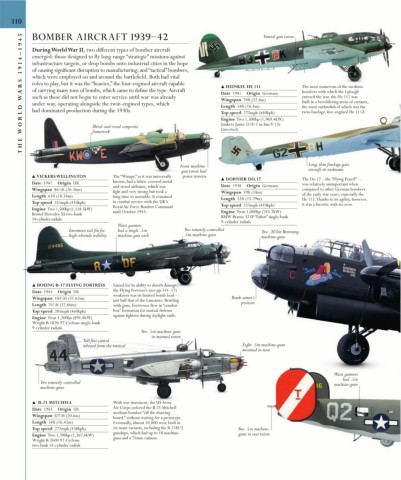
         1914–1945  During World War II, two different types of bomber aircraft


            emerged: those designed to fly long-range “strategic” missions against
            infrastructure targets, or drop bombs onto industrial cities in the hope

            which were employed on and around the battlefield. Both had vital
         ARS   of causing significant disruption to manufacturing; and “tactical” bombers,   ▲ HEINKEL HE 111  The most numerous of the medium
            roles to play, but it was the “heavies,” the four-engined aircraft capable
            of carrying many tons of bombs, which came to define the type. Aircraft
                                                                                                             bombers with which the Luftwaffe
                                                                                Date  1941     Origin  Germany
                                                                                                             entered the war, the He 111 was
            such as these did not begin to enter service until war was already
         ORLD W  under way, operating alongside the twin-engined types, which    Wingspan  74ft (22.6m)      built in a bewildering array of variants,
                                                                                Length  54ft (16.4m)
                                                                                                             the most outlandish of which was the
            had dominated production during the 1930s.
                                                                                                             twin-fuselage, five-engined He 111Z.
                                                                                Top speed  275mph (440kph)
                                                                                Engine  Two 1,300hp (1,969.4kW)
                                                                                Junkers Jumo 211F-1 in-line V-12s
         THE W                    Metal-and-wood composite                      (inverted)
                                  framework

                                                                                                               Long, thin fuselage gave
                                                                 Front machine-
                                                                                                               aircraft its nickname
                                                                  gun turret had
            ▲ VICKERS WELLINGTON         The “Wimpy,” as it was universally   power traverse  ▲ DORNIER DO.17  The Do.17—the “Flying Pencil”—
            Date  1941     Origin  UK    known, had a fabric-covered metal-                                  was relatively unimportant when
                                         and-wood airframe, which was           Date  1938     Origin  Germany
                      1
            Wingspan  86 ⁄6ft (26.26m)   light and very strong but took a       Wingspan  59ft (18m)         compared to other German bombers
            Length  61ft (18.54m)        long time to assemble. It remained     Length  52ft (15.79m)        of the early war years, especially the
                                                                                                             He 111. Thanks to its agility, however,
            Top speed  255mph (410kph)   in combat service with the UK’s                                     it was a favorite with its crew.
                                         Royal Air Force Bomber Command         Top speed  255mph (410kph)
            Engine  Two 1,500hp (1,118.5kW)   until October 1943.               Engine  Twin 1,000hp (745.7kW)
            Bristol Hercules XI two-bank                                        BMW Bramo 323P “Fafnir” single-bank
            14-cylinder radials
                                                                                9-cylinder radials
                                           Waist gunners
                         Enormous tail fin for   had a single .5in   Two remotely controlled    Two .303in Browning
                         high-altitude stability  machine-gun each  .5in machine-guns         machine-guns


            ▲ BOEING B-17 FLYING FORTRESS  Famed for its ability to absorb damage,
            Date  1943     Origin  US    the Flying Fortress’s (see pp.314–17)
                                         weakness was its limited bomb load—
            Wingspan  103 ⁄4ft (31.62m)  just half that of the Lancaster. Bristling   Bomb-aimer’s
                       3
                    1
            Length  74 ⁄3ft (22.66m)     with guns, Fortresses flew in “combat         position
            Top speed  285mph (460kph)   box” formation for mutual defense
                                         against fighters during daylight raids.
            Engine  Four 1,200hp (894.8kW)
            Wright R-1820-97 Cyclone single-bank
            9-cylinder radials
                                                   Two .5in machine-guns
                                                       in manned turret
                              Tail fins canted
                              inboard from the vertical                                Eight .5in machine-guns
                                                                                       mounted in nose


                                                                                                                        Waist gunners
                                                                                                                           had .5in
               Two remotely controlled                                                                                  machine-guns
               machine-guns

            ▲  B-25 MITCHELL             With war imminent, the US Army
            Date  1943     Origin  US    Air Corps ordered the B-25 Mitchell
                                         medium bomber “off the drawing
                      1
            Wingspan  67 ⁄2ft (20.6m)    board,” without waiting for a prototype.
            Length  54ft (16.45m)        Eventually, almost 10,000 were built in
            Top speed  272mph (438kph)   six main variants, including the B-25H/J     Two .5in machine-
                                         gunships, which had up to 18 machine-
            Engine  Two 1,700hp (1,267.6kW)                                           guns in rear turret
            Wright R-2600-92 Cyclone     guns and a 75mm cannon.
            two-bank 14-cylinder radials

