


Page 310 - (DK) Smithsinian - Military History: The Definitive Visual Guide to the Objects of Warfare
P. 310
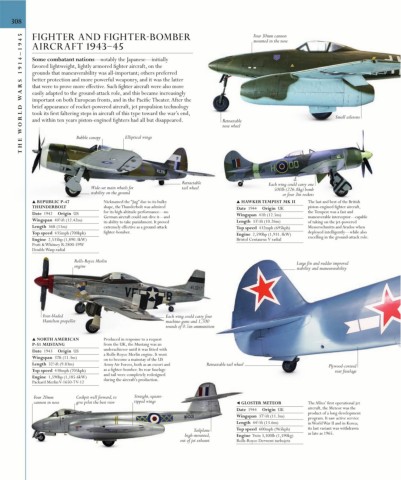
308    FIGHTER AND FIGHTER-BOMBER                                                     Four 30mm cannon

         1914–1945  AIRCRAFT 1943–45                                                       mounted in the nose


            Some combatant nations—notably the Japanese—initially
            favored lightweight, lightly armored fighter aircraft, on the

         ARS   grounds that maneuverability was all-important; others preferred
            better protection and more powerful weaponry, and it was the latter
            that were to prove more effective. Such fighter aircraft were also more
            easily adapted to the ground-attack role, and this became increasingly
         ORLD W  important on both European fronts, and in the Pacific  Theater. After the   Retractable                 Small ailerons
            brief appearance of rocket-powered aircraft, jet propulsion technology
            took its first faltering steps in aircraft of this type toward the war’s end,
            and within ten years piston-engined fighters had all but disappeared.
         THE W              Bubble canopy    Elliptical wings                   nose wheel


                                                                  Retractable                    Each wing could carry one
                                 Wide-set main wheels for         tail wheel                       500lb (226.8kg) bomb
                                 stability on the ground                                              or four 3in rockets
            ▲ REPUBLIC P-47           Nicknamed the “Jug” due to its bulky           ▲ HAWKER TEMPEST MK II    The last and best of the British
            THUNDERBOLT               shape, the Thunderbolt was admired             Date  1944     Origin  UK  piston-engined fighter aircraft,
                                      for its high-altitude performance—no                                     the  Tempest was a fast and
            Date  1942     Origin  US                                                Wingspan  41ft (12.5m)
                                      German aircraft could out-dive it—and                                    maneuverable interceptor—capable
            Wingspan  40 ⁄4ft (12.42m)                                                       1
                      3
                                      its ability to take punishment. It proved      Length  33 ⁄2ft (10.26m)  of taking on the jet-powered
            Length  36ft (11m)        extremely effective as a ground-attack         Top speed  432mph (695kph)  Messerschmitts and Arados when
            Top speed  435mph (700kph)  fighter-bomber.                              Engine  2,590hp (1,931.3kW)   deployed intelligently—while also
            Engine  2,535hp (1,890.3kW)                                              Bristol Centaurus  V radial  excelling in the ground-attack role.
            Pratt & Whitney R-2800-59W
            Double Wasp radial
                           Rolls-Royce Merlin
                                                                                                           Large fin and rudder improved
                           engine
                                                                                                           stability and maneuverability


                Four-bladed                                 Each wing could carry four
                Hamilton propeller                          machine-guns and 1,700
                                                            rounds of 0.5in ammunition

            ▲ NORTH AMERICAN          Produced in response to a request
            P-51 MUSTANG              from the UK, the Mustang was an
            Date  1943     Origin  US  underachiever until it was fitted with
                                      a Rolls-Royce Merlin engine. It went
            Wingspan  37ft (11.3m)
                                      on to become a mainstay of the US
                    1
            Length  32 ⁄4ft (9.83m)   Army Air Forces, both as an escort and   Retractable tail wheel                 Plywood-covered
            Top speed  438mph (705kph)  as a fighter-bomber. Its rear fuselage                                          rear fuselage
                                      and tail were completely redesigned
            Engine  1,590hp (1,185.6kW)
            Packard Merlin V-1650-7 V-12  during the aircraft’s production.
             Four 20mm      Cockpit well forward, to    Straight, square-
             cannon in nose  give pilot the best view  tipped wings                  ◀ GLOSTER METEOR          The Allies’ first operational jet
                                                                                     Date  1944     Origin  UK  aircraft, the Meteor was the
                                                                                                               product of a long development
                                                                                               1
                                                                                     Wingspan  37 ⁄4ft (11.3m)
                                                                                                               program. It saw active service
                                                                                     Length  44 ⁄2ft (13.6m)   in World War II and in Korea;
                                                                                             1
                                                                      Tailplane      Top speed  600mph (965kph)  its last variant was withdrawn
                                                                   high-mounted,     Engine  Twin 3,500lb (1,590kg)   as late as 1965.
                                                                 out of jet exhaust  Rolls-Royce Derwent turbojets

