


Page 308 - (DK) Smithsinian - Military History: The Definitive Visual Guide to the Objects of Warfare
P. 308
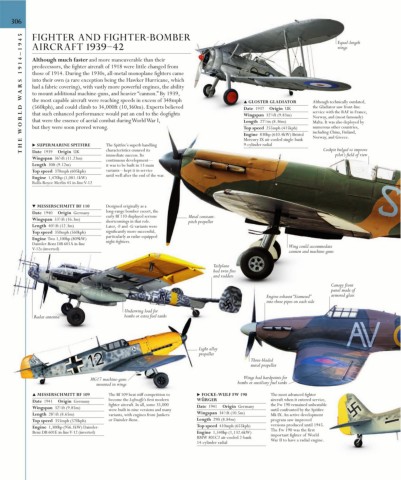
306    FIGHTER AND FIGHTER-BOMBER

         1914–1945  AIRCRAFT 1939–42                                                                                     Equal-length

                                                                                                                         wings

            Although much faster and more maneuverable than their
            predecessors, the fighter aircraft of 1918 were little changed from

         ARS   those of 1914. During the 1930s, all-metal monoplane fighters came
            into their own (a rare exception being the Hawker Hurricane, which
            had a fabric covering), with vastly more powerful engines, the ability
            to mount additional machine-guns, and heavier “cannon.” By 1939,
         ORLD W  the most capable aircraft were reaching speeds in excess of 348mph     ▲ GLOSTER GLADIATOR      Although technically outdated,
            (560kph), and could climb to 34,000ft (10,360m). Experts believed
                                                                                                                 the Gladiator saw front-line
                                                                                        Date  1937     Origin  UK
                                                                                                                 service with the RAF in France,
            that such enhanced performance would put an end to the dogfights
                                                                                                 1
                                                                                        Wingspan  32 ⁄4ft (9.83m)
                                                                                                                 Norway, and (most famously)
            that were the essence of aerial combat during World War I,
                                                                                               1
                                                                                        Length  27 ⁄2in (8.36m)
                                                                                                                 Malta. It was also deployed by
         THE W  but they were soon proved wrong. The Spitfire’s superb handling         Top speed  255mph (415kph)  numerous other countries,
                                                                                                                 including China, Finland,
                                                                                        Engine  830hp (610.4kW) Bristol
                                                                                                                 Norway, and Greece.
                                                                                        Mercury IX air-cooled single-bank
                                                                                        9-cylinder radial
            ▶ SUPERMARINE SPITFIRE
                                       characteristics ensured its
            Date  1939     Origin  UK
                                       immediate success. Its                                                       Cockpit bulged to improve
                                                                                                                         pilot’s field of view
                      3
            Wingspan  36 ⁄4ft (11.23m)
                                       continuous development—
            Length  30ft (9.12m)       it was to be built in 13 main
            Top speed  378mph (605kph)  variants—kept it in service
                                       until well after the end of the war.
            Engine  1,470hp (1,081.1kW)
            Rolls-Royce Merlin 45 in-line V-12
            ▼ MESSERSCHMITT BF 110     Designed originally as a
            Date  1940     Origin  Germany  long-range bomber escort, the
                                       early Bf 110 displayed serious   Metal constant-
                      1
            Wingspan  53 ⁄3ft (16.3m)  shortcomings in that role.    pitch propeller
                    1
            Length  40 ⁄2ft (12.3m)    Later, -F and -G variants were
            Top speed  350mph (560kph)  significantly more successful,
                                       particularly as radar-equipped
            Engine  Two 1,100hp (809kW)   night-fighters.
            Daimler-Benz DB 601A in-line                                                                Wing could accommodate
            V-12s (inverted)
                                                                                                        cannon and machine-guns
                                                                             Tailplane
                                                                             had twin fins
                                                                             and rudders
                                                                                                                       Canopy front
                                                                                                                       panel made of
                                                                                                Engine exhaust “Siamesed”    armored glass
                                                                                                into three pipes on each side
                                             Underwing load for
             Radar antenna                   bombs or extra fuel tanks
                                                                        Light alloy
                                                                        propeller
                                                                                          Three-bladed
                                                                                          metal propeller

                                 MG17 machine-guns                                      Wings had hardpoints for
                                   mounted in wings                                   bombs or auxiliary fuel tanks
            ▲ MESSERSCHMITT BF 109      The Bf 109 beat stiff competition to   ▶ FOCKE-WULF FW 190   The most advanced fighter
            Date  1941     Origin  Germany  become the Luftwaffe’s first modern   WÜRGER          aircraft when it entered service,
                                        fighter aircraft. In all, some 35,000                     the Fw 190 remained unbeatable
                      1
            Wingspan  32 ⁄3ft (9.85m)   were built in nine versions and many   Date  1941     Origin  Germany  until confronted by the Spitfire
                                                                                 1
            Length  28 ⁄3ft (8.65m)     variants, with engines from Junkers    Wingspan  34 ⁄2ft (10.5m)  Mk IX. An active development
                    1
            Top speed  355mph (570kph)  or Daimler-Benz.               Length  29ft (8.84m)       program saw improved
            Engine  1,300hp (956.1kW) Daimler-                         Top speed  410mph (655kph)  versions produced until 1945.
            Benz DB 601E in-line V-12 (inverted)                       Engine  1,540hp (1,132.6kW)   The Fw 190 was the first
                                                                       BMW 801C2 air-cooled 2-bank   important fighter of  World
                                                                       14-cylinder radial         War II to have a radial engine.

