


Page 316 - (DK) Smithsinian - Military History: The Definitive Visual Guide to the Objects of Warfare
P. 316
314    WORLD WAR II LONG-RANGE HEAVY BOMBER                                                                          Dorsal turret

         1914–1945  BOEING B-17                                                             Rear turret  Tail fin    Ventral (ball) turret  Chin gun


         ARS  FLYING FORTRESS                                                                          Plexiglass nose  Cheek gun  Radial engines
                                                                                                       and rudder
                                                                                                                       CROSS SECTION

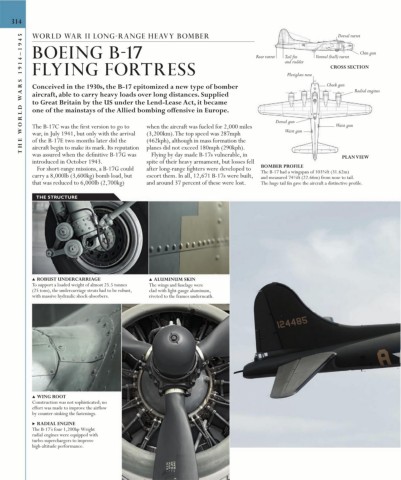
            Conceived in the 1930s, the B-17 epitomized a new type of bomber

         ORLD W  aircraft, able to carry heavy loads over long distances. Supplied                 Dorsal gun            Waist gun
            to Great Britain by the US under the Lend-Lease Act, it became
            one of the mainstays of the Allied bombing offensive in Europe.

                                                     when the aircraft was fueled for 2,000 miles
            The B-17C was the first version to go to
         THE W  war, in July 1941, but only with the arrival    (3,200km). The top speed was 287mph    Waist gun
                                                     (462kph), although in mass formation the
            of the B-17E two months later did the
            aircraft begin to make its mark. Its reputation  planes did not exceed 180mph (290kph).
            was assured when the definitive B-17G was   Flying by day made B-17s vulnerable, in                            PLAN VIEW
            introduced in October 1943.              spite of their heavy armament, but losses fell
              For short-range missions, a B-17G could   after long-range fighters were developed to   BOMBER PROFILE
            carry a 8,000lb (3,600kg) bomb load, but   escort them. In all, 12,671 B-17s were built,   The B-17 had a wingspan of 103¾ft (31.62m)
                                                                                              and measured 74⅓ft (22.66m) from nose to tail.
            that was reduced to 6,000lb (2,700kg)    and around 37 percent of these were lost.  The huge tail fin gave the aircraft a distinctive profile.


              THE STRUCTURE


            ▲ ROBUST UNDERCARRIAGE                    ▲ ALUMINUM SKIN
            To support a loaded weight of almost 25.5 tonnes    The wings and fuselage were
            (25 tons), the undercarriage struts had to be robust,    clad with light-gauge aluminum,
            with massive hydraulic shock-absorbers.   riveted to the frames underneath.


            ▲ WING ROOT
            Construction was not sophisticated; no
            effort was made to improve the airflow
            by counter-sinking the fastenings.

            ▶ RADIAL ENGINE
            The B-17’s four 1,200hp  Wright
            radial engines were equipped with
            turbo-superchargers to improve
            high-altitude performance.

