


Page 313 - (DK) Smithsinian - Military History: The Definitive Visual Guide to the Objects of Warfare
P. 313
311
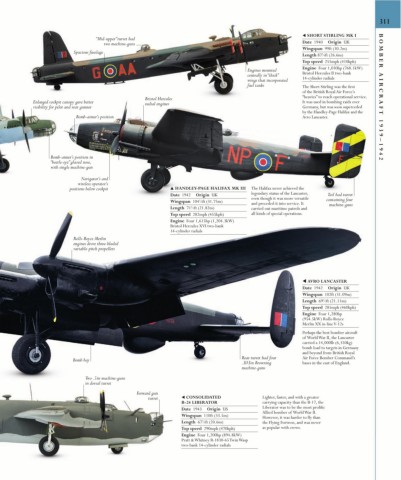
◀ SHORT STIRLING MK I
“Mid-upper” turret had
two machine-guns Date 1940 Origin UK
Wingspan 99ft (30.2m)
Spacious fuselage
1
Length 87 ⁄4ft (26.6m)
Top speed 255mph (410kph)
Engine Four 1,030hp (768.1kW)
Engines mounted
centrally in “thick” Bristol Hercules II two-bank BOMBER AIRCRAFT
wings that incorporated 14-cylinder radials
fuel tanks The Short Stirling was the first
of the British Royal Air Force’s
“heavies” to reach operational service.
Bristol Hercules
Enlarged cockpit canopy gave better radial engines It was used in bombing raids over
visibility for pilot and rear gunner Germany, but was soon superceded
by the Handley-Page Halifax and the
Bomb-aimer’s position Avro Lancaster.
Bomb-aimer’s position in 1939–1942
“beetle-eye” glazed nose,
with single machine-gun
Navigator’s and
wireless operator’s
positions below cockpit ▲ HANDLEY-PAGE HALIFAX MK III The Halifax never achieved the
Date 1942 Origin UK legendary status of the Lancaster, Tail had turret
even though it was more versatile containing four
1
Wingspan 104 ⁄4ft (31.75m)
and preceded it into service. It machine-guns
1
Length 71 ⁄2ft (21.82m) carried out maritime patrols and
Top speed 282mph (455kph) all kinds of special operations.
Engine Four 1,615hp (1,204.3kW)
Bristol Hercules XVI two-bank
14-cylinder radials
Rolls-Royce Merlin
engines drove three-bladed
variable-pitch propellers
◀ AVRO LANCASTER
Date 1942 Origin UK
Wingspan 102ft (31.09m)
1
Length 69 ⁄3ft (21.11m)
Top speed 285mph (460kph)
Engine Four 1,280hp
(954.5kW) Rolls-Royce
Merlin XX in-line V-12s
Perhaps the best bomber aircraft
of World War II, the Lancaster
carried a 14,000lb (6,350kg)
bomb load to targets in Germany
and beyond from British Royal
Rear turret had four Air Force Bomber Command’s
Bomb bay
.303in Browning bases in the east of England.
machine-guns
Two .5in machine-guns
in dorsal turret
Forward gun
turret ◀ CONSOLIDATED Lighter, faster, and with a greater
B-24 LIBERATOR carrying capacity than the B-17, the
Date 1943 Origin US Liberator was to be the most prolific
Allied bomber of World War II.
Wingspan 110ft (33.5m)
However, it was harder to fly than
Length 67 ⁄3ft (20.6m) the Flying Fortress, and was never
2
Top speed 290mph (470kph) as popular with crews.
Engine Four 1,200hp (894.8kW)
Pratt & Whitney R-1830-65 Twin Wasp
two-bank 14-cylinder radials

